
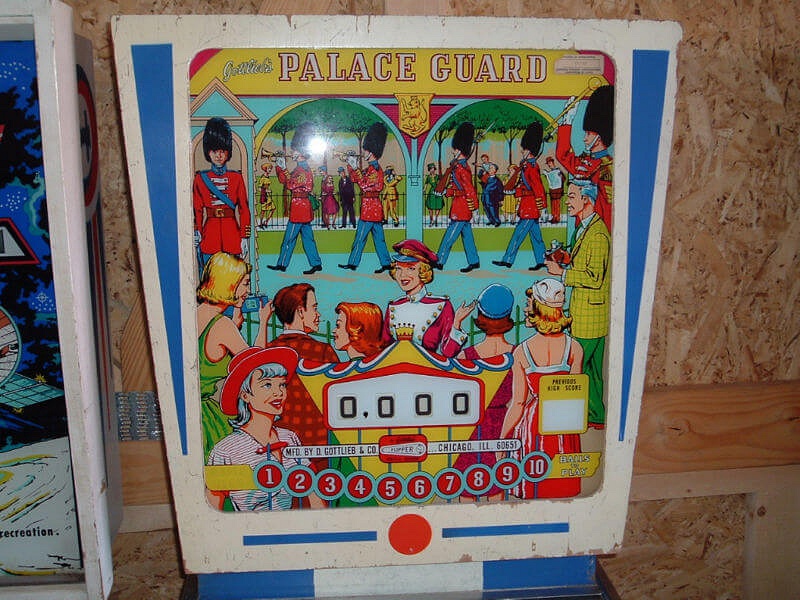
Palace Guard, a 1968 classic from the golden age of Gottlieb, stands as a masterclass in minimalist design by the legendary Ed Krynski. With vibrant, exotic art by Art Stenholm, this single-player add-a-ball machine invites players into a world of royal intrigue. Despite its modest footprint, the playfield is deceptively tactical, utilizing a pair of flippers to navigate a layout packed with four pop bumpers, two slingshots, and a robust array of six standup targets complemented by four snap targets. It is a quintessential EM experience where the mechanical chime of the score reels rewards precision and patience.
The depth of gameplay rests on the interplay between the top lanes and the target banks. Sweeping through all five top lanes is a priority, as it sets the stage for a “special” at the “C” lane—a status that carries over between balls, rewarding long-term planning. Meanwhile, the standup target bank acts as the game’s engine; hitting these targets shifts the scoring landscape, lighting up pops or rear standups for varying point values. A savvy player will focus on lighting the drains for 500-point bonuses while keeping the ball in the orbit of the rear standups, where repeated deflections off the pop bumpers can turn a standard round into a high-scoring marathon.
Success on Palace Guard requires managing the ever-shifting state of the board. Because the special at the fan targets migrates based on switch activity, you must stay alert to the machine’s rhythm. While the game’s production run was limited to just 625 units, its enduring appeal lies in the satisfaction of clearing the board and chasing that elusive add-a-ball. For those who appreciate the tactile, unforgiving charm of vintage Gottlieb engineering, this machine serves as a perfect, high-tension test of endurance.