
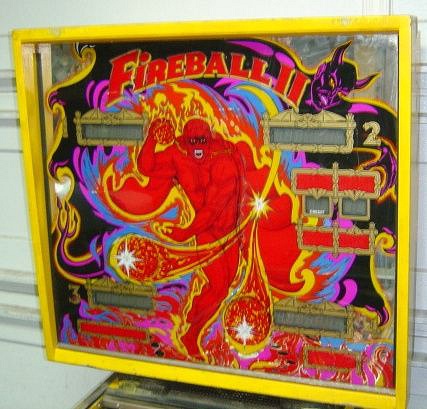
Fireball II, Bell Games’ solid-state offering from the early 1980s, plunges up to four players into a vibrant fantasy theme brimming with infernal powers and demonic imagery. While no specific designer is credited, the machine’s gameplay showcases a classic yet challenging layout for its era, built around a conventional three-flipper setup. The playfield is animated by three lively pop bumpers and a formidable array of drop targets, including two banks of four and a singular bank of three, all serving as critical shot objectives. A central kick-out hole further demands precision, often acting as a gateway to key features.
The strategic depth of Fireball II largely centers on its distinctive multiball initiation and bonus systems. Players must aim for the top-left targets to illuminate the ball locks, channeling balls into internal mechanisms. Once at least one ball is secured, completing the lock targets once more unleashes all locked balls into a chaotic multi-ball frenzy. Beyond this, the game introduces “Little Devil Credits,” which are earned by striking the center target bank—a shot that concurrently advances a “Doomsday bonus” multiplier. These credits are vital for activating a retractable center post kicker, a crucial defensive tool to avert untimely drains. Furthermore, skilled players will prioritize lighting one of the playfield’s saucers, which periodically becomes active to collect a “FIREBALL bonus” that compounds with the current bonus multiplier, offering significant scoring potential.
For competitive play, Fireball II demands a careful balance of offensive aggression and defensive resource management. Maximizing the FIREBALL bonus is paramount, requiring players to systematically hit the ABCD targets to advance its multiplier. An advanced technique, known as “Shatz,” involves precisely shooting opposite inlanes to accurately strike the C and D targets, a high-risk, high-reward maneuver for rapid bonus progression. Savvy players must also weigh the immediate utility of the center post kicker against the long-term benefit of its credits; any unused “Little Devil Credits” are converted into a substantial 10,000-point bonus payout per credit on ball three, making careful management essential, particularly when on the cusp of a game-ending tilt. This intricate interplay of targeting and resource allocation defines Fireball II’s enduring challenge and appeal.