
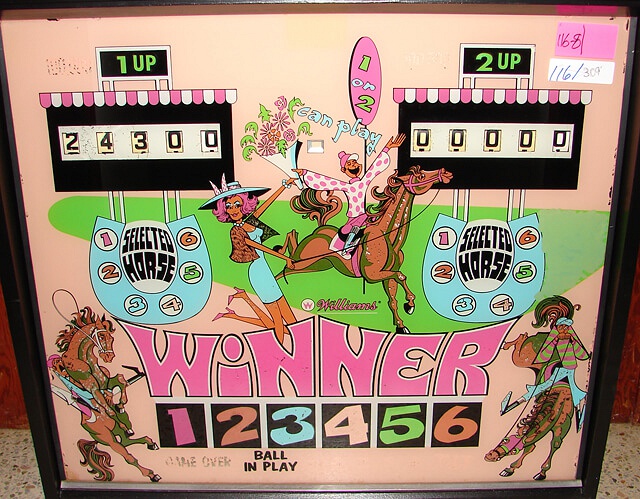
Winner, a 1972 widebody release from Williams, stands as a fascinating relic of the early transition into larger playfield real estate. Designed by industry legend Steve Kordek and featuring the distinct, high-contrast aesthetics of artist Christian Marche, this sports-themed machine trades the frenetic pace of modern pins for the calculated tension of the racetrack. Stretching out across a generous widebody cabinet, the game utilizes a unique four-flipper layout that demands a different kind of spatial awareness, forcing players to manage the ball across a sprawling expanse of horse racing-inspired targets.
The mechanical heart of Winner lies in its target array, specifically the eight hanging targets that challenge the player’s accuracy as they simulate the tight competition of the track. Because the game lacks the deep rulesets of later eras, success here is defined by pure target management and mastering the geometry of the four flippers. With only two standup targets to complement the hanging array, the playfield feels remarkably open and vintage, rewarding consistent, rhythmic shots rather than complex ball paths. It is a quintessential Kordek design—simple in its objective but challenging in its execution, offering a two-player experience that feels like a trip back to the golden age of electromechanical sports gaming.