
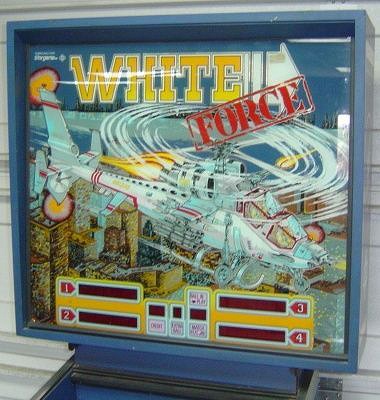
White Force, a solid-state release from Unidesa, stands as a curious relic of the European arcade scene, showcasing a minimalist approach to late-era design. While it lacks the glitz of the massive licensed franchises that dominated the market, it relies on a tight, geometric layout that favors precision over spectacle. With its classic three-flipper configuration and standard alphanumeric display, the machine evokes the utilitarian charm of 1980s European gaming, demanding a steady hand to navigate its straightforward but punishing playfield.
The mechanical architecture centers on a quartet of drop targets that serve as the primary objective for scoring multipliers and bonus advancement. Complementing this bank is a solitary drop target, which often acts as the key to unlocking the kick-out hole for high-value rewards. Flow is maintained through a well-placed rollunder spinner, which provides that satisfying, rapid-fire auditory feedback synonymous with the era. The inclusion of three pop bumpers adds a chaotic, unpredictable element to the ball’s movement, often forcing players to react quickly as the ball careens toward the lower playfield.
Mastering White Force requires a disciplined approach to the drop targets; failing to clear them efficiently leaves the player chasing low-scoring shots that quickly become liabilities. Because the game lacks the complex multi-ball modes of modern machines, success hinges on hitting the solitary drop target consistently to feed the kick-out hole, maximizing your bonus before the ball inevitably finds the outlanes. It is a no-frills, high-stakes experience that rewards players who prefer the raw, mechanical rhythm of vintage solid-state pins over the digital density of contemporary displays.