
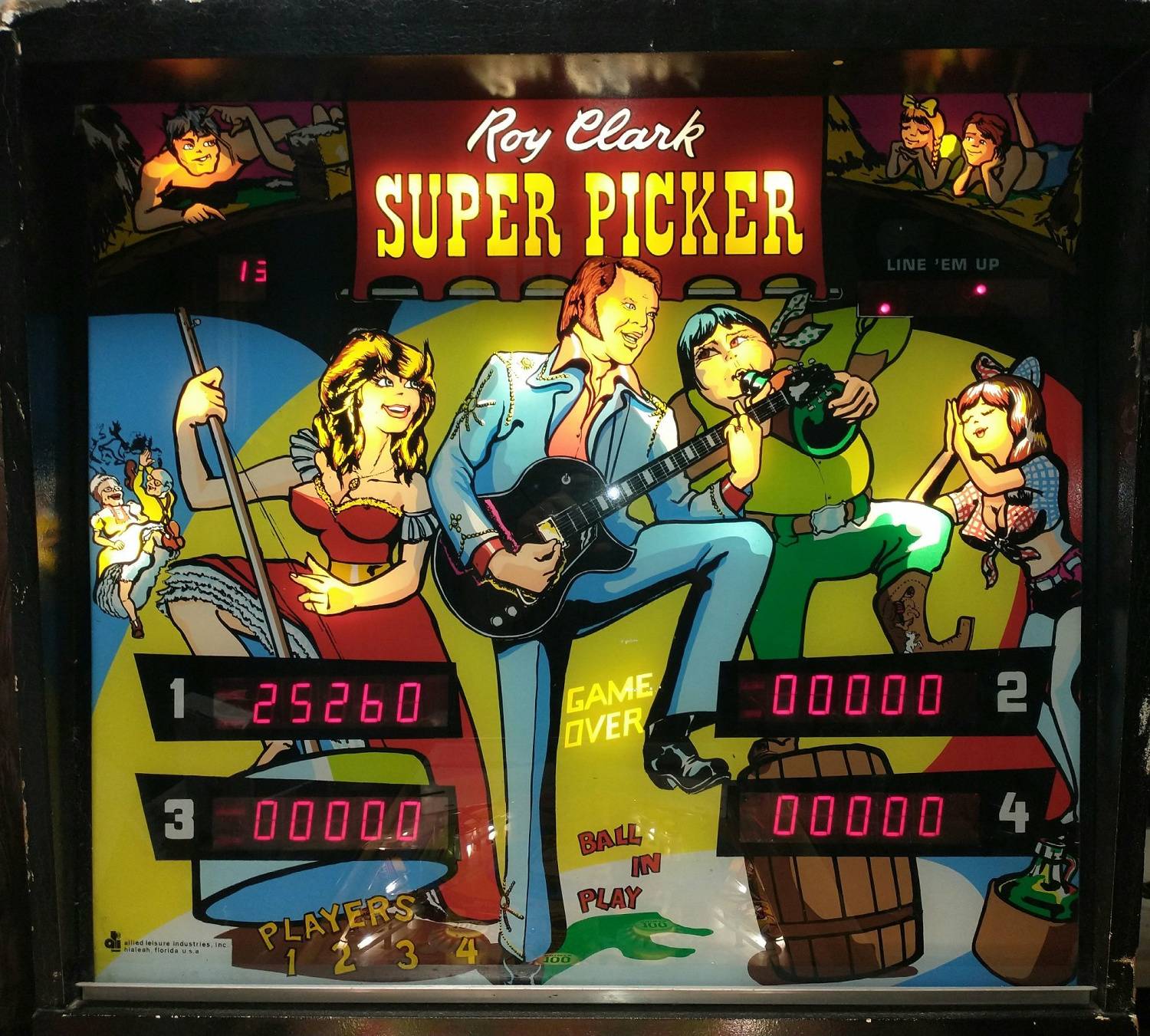
Roy Clark Super Picker stands as a quintessential artifact of the late 1970s, representing Allied Leisure’s foray into the celebrity-licensed solid-state era. Designed by Bob Betor, the machine captures the homespun, energetic charm of its namesake, the legendary country guitar virtuoso. While it lacks the complex mechanical density of modern machines, the playfield is built on a straightforward, rhythmic foundation that mirrors the pluck of a banjo or the frantic strumming of a country standard, utilizing a classic two-flipper layout to navigate its trio of pop bumpers and slingshots.
The gameplay experience is stripped-down and focused, relying on three primary standup targets to drive the scoring progression. It is a game that values precision over pyrotechnics, tasking the player with hitting these specific markers to build momentum. Because the feature set is lean, the challenge lies in mastering the geometry of the playfield to keep the ball away from the outlanes and active within the bumper clusters. It serves as a fascinating historical snapshot of a time when the industry was shifting toward digital scoring while still clinging to the minimalist, high-stakes charm of earlier EM-style layouts.
For the modern collector, Super Picker is less about deep rulesets and more about the aesthetic of a bygone era in country music entertainment. With its two-player capacity and alphanumeric display, it functions as a nostalgic time capsule. Players looking to squeeze every point out of this machine should prioritize the standup targets early to maximize multipliers before the ball inevitably finds the drain, as the simple geometry leaves little room for recovery once the ball loses its initial energy.