
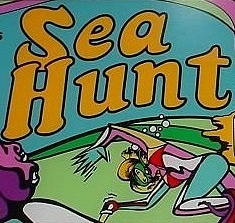
Sea Hunt, released by Allied Leisure in 1977, stands as a curious relic of the late electromechanical era, showcasing the inventive, often experimental spirit of designer Ron Halliburton. Eschewing the conventional pinball aesthetic for a nautical theme, the machine immerses players in a world of scuba diving and underwater exploration. Its most distinct calling card is its status as a “shaker ball” machine, a mechanical anomaly that differentiates it from the standard drop-target-heavy fare of the mid-70s. With Roland Berrios lending his artistic hand to the aquatic visuals, the playfield feels like a submerged adventure, punctuated by a quartet of pop bumpers that provide the frantic, unpredictable action synonymous with the period.
Mechanically, the game is a straightforward affair, relying on a classic two-flipper layout and a half-dozen standup targets to drive the scoring. While modern machines might rely on complex rule sets and deep software, Sea Hunt captures the charm of a simpler time, where success hinged on mastering the rebound angles off the slingshots and keeping the ball clear of the outlanes. It is a one-player experience that demands rhythm and a steady hand, rewarding those who can navigate the pop-bumper garden to maintain ball control.
For the modern collector, Sea Hunt is less about deep tournament strategy and more about the tactile, rhythmic joy of a vintage shaker-style mechanism. It serves as a stark reminder of a time when manufacturers were still tinkering with the core physics of the game, looking for new ways to manipulate the ball’s movement beyond the traditional flipper shot. It is a quirky, deep-sea diversion that offers a refreshing, stripped-down alternative to the high-tech spectacles of today’s arcade landscape.