
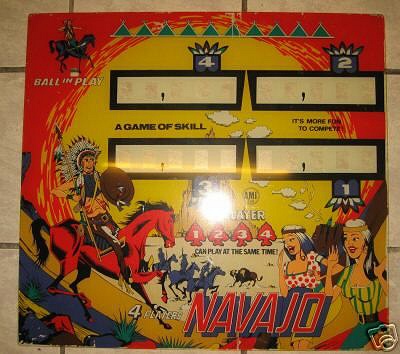
Navajo, released by A.M.I., stands as a stark, vintage relic of the mid-century electromechanical era. With artwork credited to Michele “Mike” Martinelli, the machine leans into a classic aesthetic that prioritizes the tactile, rhythmic clatter of mechanical score reels over the complex digital displays of modern tables. Designed for up to four players, the game offers a stripped-back, competitive experience that forces the user to focus on fundamental ball control rather than navigating deep rulesets or convoluted mission modes.
The playfield layout is a masterclass in minimalism, reflecting the design philosophy of an era where the game’s challenge was derived purely from geometry and gravity. Whether configured for three or five-ball play, the machine demands precision; without the safety nets of modern ball saves or magnets, every shot is a high-stakes commitment. The sparse, open design emphasizes the importance of mastering the slingshots and flipper timing, making it a punishing but rewarding test of raw pinball skill.
For players seeking to conquer Navajo, success lies in the discipline of the opening plunge and consistent accuracy on the playfield’s primary targets. Because the machine lacks the “toys” and cinematic flair of contemporary releases, the strategy is refreshingly transparent: maintain ball possession, avoid the side drains, and capitalize on the bonus multipliers that accumulate through steady, repetitive target hits. It is a quintessential “player’s game,” perfect for those who want to strip away the noise and get back to the core physics that define the hobby.