
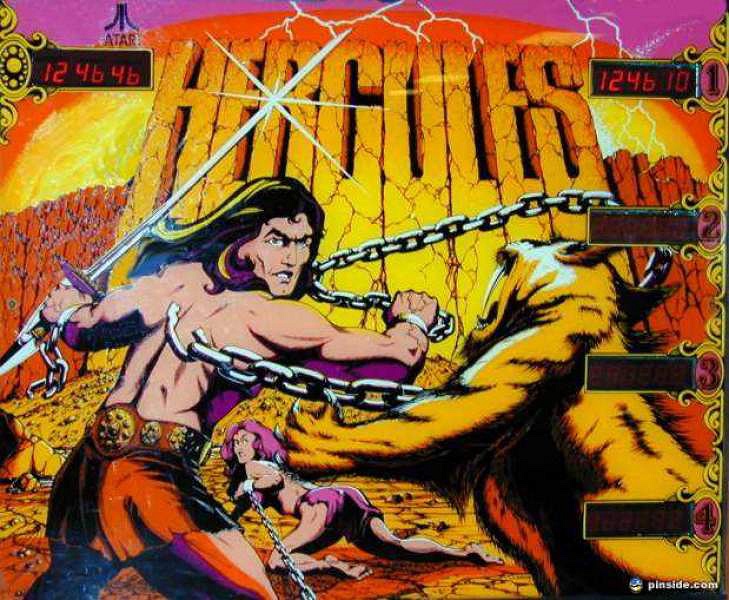
Hercules, released by Atari in 1979, remains a monumental oddity in the history of arcade gaming. Designed by Steve Bicker with striking illustrative work by Jim Kelly, this machine is best known for its sheer physical scale. As a gargantuan widebody table, it dwarfs standard cabinets, utilizing a massive, heavy pinball that feels more like a billiard ball than the standard steel spheres players are accustomed to. This isn’t a game of finesse or rapid-fire combos; it is a lumbering, tactile experience that requires players to adjust their timing to the sluggish, heavy momentum of the playfield.
The mechanical layout is surprisingly minimalist given the cabinet’s footprint. Eschewing the complex multi-ball toys or dense ramp networks of modern machines, Hercules relies on two flippers, a pair of pop bumpers, and a central spinning target to challenge the player. The goal is simple: survive the onslaught of the massive ball as it travels across the sprawling playfield. Because the ball’s weight prevents the typical snappy reaction times found in other solid-state games, success here demands a patient, deliberate approach, focusing on controlling the ball’s lumbering trajectory rather than attempting high-speed shots.
For the vintage collector, Hercules is less about deep rulesets and more about the spectacle of engineering. It stands as a fascinating relic of the late 70s, a time when manufacturers were experimenting with just how far they could push the boundaries of the pinball form factor. While it lacks the intricate scoring modes of contemporary machines, its unique physics and imposing size offer a one-of-a-kind challenge that tests a player’s ability to tame a ball that simply refuses to obey the laws of standard pinball speed.