
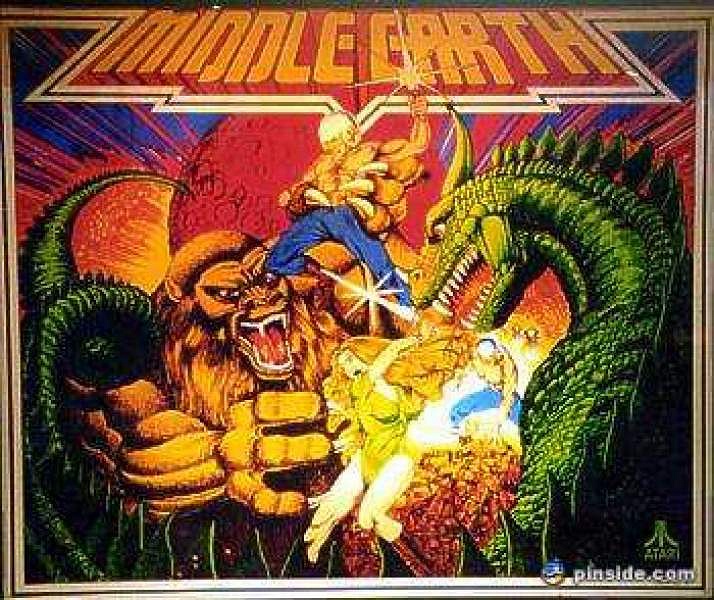
Middle Earth, released by Atari in 1978, stands as a quintessential relic of the late-seventies widebody craze. Designed by Gary Slater with striking, iconic fantasy artwork by George Opperman, the game leans heavily into the high-adventure aesthetic that defined the era. Its expansive playfield offers a sprawling, open canvas that forces players to navigate a complex geometry of shots, anchored by a pair of five-bank drop target arrays that demand precision rather than brute force.
The mechanical layout is surprisingly dense for its footprint, utilizing four flippers to manage the widebody’s unique momentum. A distinctive horseshoe lane cuts through the center of the design, creating a challenging rhythm for players aiming to cycle the ball across the playfield. Complementing this are dual spinning targets that reward aggressive shooting, while a series of five standup targets and a pair of pop bumpers provide the erratic, high-energy action expected from Atari’s solid-state machines.
Mastering Middle Earth requires a disciplined approach to the side-to-side flow. Because the wide playfield creates longer travel distances for the ball, successful players focus on clearing one of the five-bank drop targets to open up high-scoring lanes rather than simply chasing the bumpers. By utilizing the upper flippers to manage the ball’s transition through the horseshoe, you can maintain control and avoid the wide-open drains that often punish hasty shots. It remains a fascinating piece of pinball history, capturing the ambition of a company that wasn’t afraid to push the physical boundaries of the cabinet.