
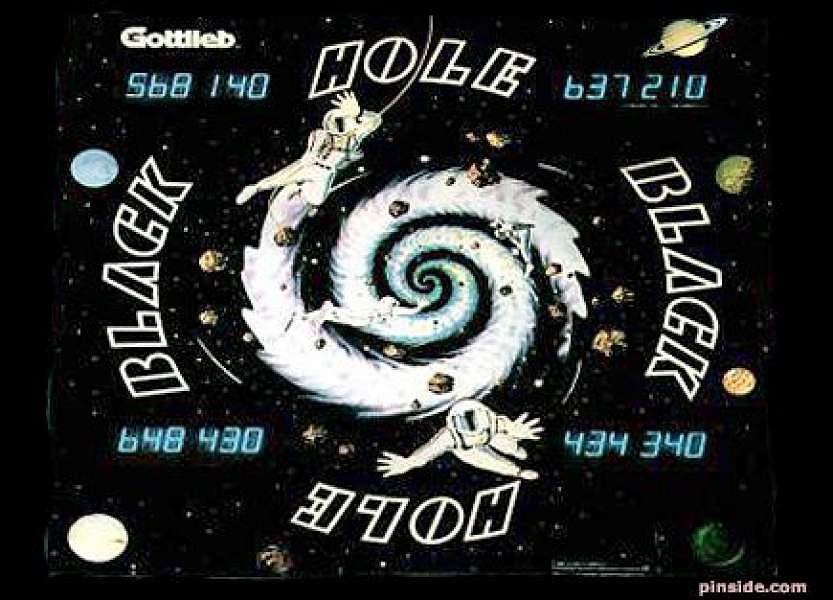
Gottlieb’s 1981 Black Hole is the machine that quite literally took pinball to a new level — a lower playfield sloped away beneath the main field, flippers tucked up at the backbox end, gravity itself working against you. Designed by John Buras and Shing Lam with art by Terry Doerzaph, it was the first game to send your ball downstairs into a separate arena, complete with multiball and (on non-export models) eerie speech and a rotating backglass disc. Nearly 8,800 were built, and few early solid-state titles have aged into legend quite like this swirling slab of outer-space dread.
The strategy runs deep for a game of its era. The crux is the G-Force Accelerator: spell B-L-A-C-K and H-O-L-E across the drop banks in order to multiply the lower playfield, two-times for the first bank, three-times for both, and that two-times multiplier can even carry between balls if you protect it. Smart players prioritize the lower lock, because a ball stashed down there survives a drain upstairs — a crucial bit of insurance. The upper saucer ejects each ball while the lower capture clings to yours, and yes, a rival can steal it, so guard your investment. Lighting four yellow standups arms the upper saucer, and locking in both captive holes spins up the Gravity Tunnel toward a three-ball frenzy.
Here’s the honest truth competitors respect: the multiball can be brutal and short, so there’s real wisdom in getting that Accelerator to three-times and grinding the lower level for points. Black Hole isn’t just a gimmick — it’s a vertical chess match against gravity, and it still pulls players in.