
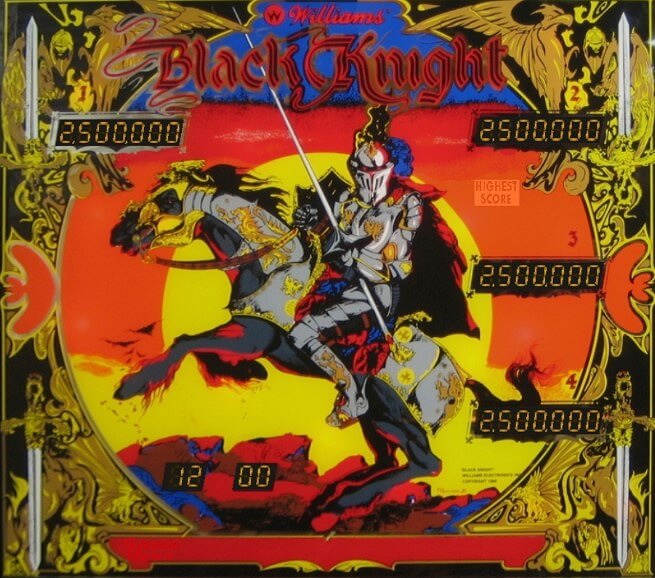
Williams’ Black Knight, released in 1980, is a foundational machine in pinball history — the table that introduced the multi-level playfield and the patented Magna-Save, both from a young Steve Ritchie who would become the most celebrated designer in the game. Its sneering, talking Black Knight (voiced by Ritchie himself) taunted players in a way no machine had before, and its split-level layout with three ramps felt genuinely revolutionary at the dawn of the solid-state era.
The signature feature is Magna-Save: button-triggered magnets on the inlanes that can pull a draining ball back from the brink. The strategic heart of the game is using them wisely — shoot the center horseshoe for bonus multiplier, but only with a Magna-Save lit on the left outlane and ready to deploy. Locking balls in the upper saucer builds toward a two- or three-ball multiball (best started on the upper playfield), and on hard settings the lower-playfield horseshoe lights the lock. A crucial habit: keep the right flipper raised as you plunge, or the ball comes screaming straight down to the lower playfield.
Historic, influential, and still a genuine challenge, Black Knight is where so many modern ideas began — the two-level playfield, the save magnet, the trash-talking villain. For collectors tracing the roots of the contemporary game, this Ritchie landmark is an essential and endlessly satisfying piece of the story.