
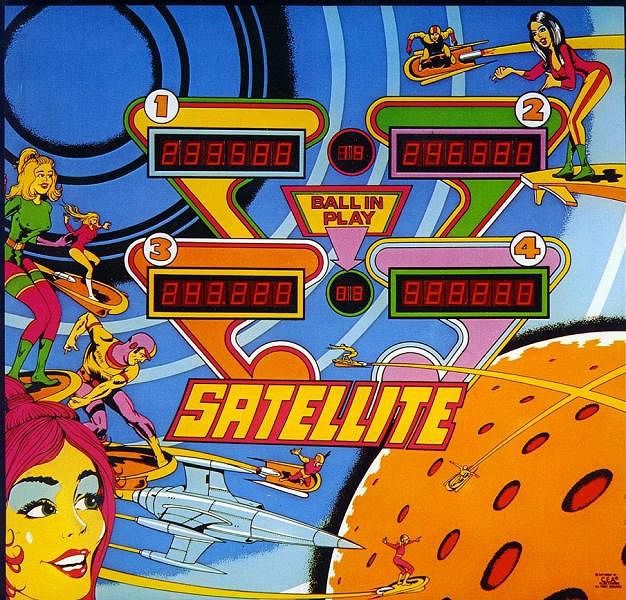
Satellite, a solid-state offering from C.E.A., serves as a fascinating relic of an era when European manufacturers were experimenting with the interplay between traditional mechanical layouts and early digital scoring. With artwork helmed by Michele “Mike” Martinelli, the table leans into a space-age aesthetic that fits its moniker, presenting a clean, focused playfield that relies on classic geometry rather than the cluttered toy-heavy designs that would dominate later decades.
The mechanical heart of Satellite is centered on its two-flipper configuration, which demands precision to navigate the seven standup targets and the spinning target that anchors the scoring progression. The inclusion of a messenger ball introduces a layer of chaotic physics, forcing players to account for the unpredictable movement of a secondary sphere that can drastically alter the trajectory of the primary ball. A kick-out hole provides the necessary relief and reward for accurate shots, while the two pop bumpers and star rollovers keep the pace brisk and the feedback tactile.
For those looking to master this machine, success hinges on controlling the spinning target to build multipliers while keeping the messenger ball in check. Because the playfield lacks the safety nets of modern multi-ball heavyweights, tournament-style play on Satellite rewards a disciplined approach: prioritize the star rollovers to light your bonuses and avoid the temptation of wild shots at the standup bank. It is a no-nonsense, skill-testing experience that showcases how much depth can be extracted from a deceptively simple set of mechanical features.