
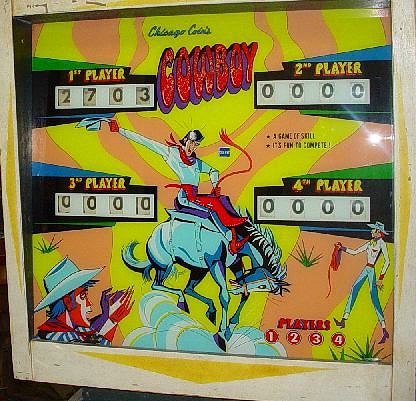
Cowboy, released by Chicago Coin in 1970, serves as a quintessential example of the late-era EM charm that defined the classic arcade experience. Designed by Jerry Koci, this four-player machine leans heavily into the rugged aesthetic of the American West, stripping away modern complexity in favor of the rhythmic, satisfying clack of mechanical score reels. The playfield is anchored by a pair of five-inch “jumbo” flippers, which provide a distinct, heavy-duty feel that rewards precise timing and patience over the rapid-fire speed of later solid-state designs.
The mechanical layout is surprisingly focused, utilizing a spread of four pop bumpers to create chaotic ball trajectories that demand quick reactions. To keep the action flowing, Koci integrated two rollunders and a central kick-out hole, which serve as the primary targets for building your score. The inclusion of a center up-post—a hallmark of the era’s defensive play—gives players a fighting chance to save a ball that would otherwise drain straight down the middle, transforming a potential disaster into a moment of strategic relief.
While it lacks the deep rule sets of contemporary machines, Cowboy excels in its simplicity and tactile feedback. Navigating the playfield requires a mastery of the jumbo flippers’ wide reach, as the geometry of the bumpers often sends the ball into unpredictable arcs. For the vintage enthusiast, this machine is a masterclass in clean, competitive design, proving that you don’t need an array of digital toys to capture the high-stakes tension of a desert shootout.