
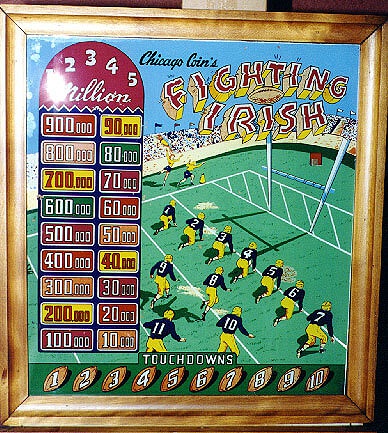
Fighting Irish, the 1950s gridiron-themed offering from Chicago Coin, stands as a quintessential relic of the early electro-mechanical era. With artwork masterfully rendered by the legendary Roy Parker, the game captures the gritty, spirited nostalgia of college football’s golden age. It is a stripped-back, single-player affair that eschews the bells and whistles of modern cabinets in favor of pure, rhythmic action, relying on a classic two-flipper configuration to navigate the playfield.
The mechanical layout is deceptively simple, centered around a pair of pop bumpers that serve as the primary defensive line, forcing the ball into unpredictable trajectories that demand quick reactions. A strategically placed kick-out hole anchors the scoring potential, rewarding precise shots with the kind of immediate gratification that defined the arcade experience of the mid-20th century. By focusing on fundamental geometry and timing rather than complex modes, Fighting Irish forces the player to master the basics of ball control.
For those looking to dominate the scoreboard, the key lies in managing the momentum generated by the pop bumpers. Because the game lacks the deep rule sets of contemporary machines, success is entirely dependent on your ability to trap the ball and accurately aim for the kick-out hole to maximize your point accumulation. It is a high-stakes game of field position, where every successful strike feels like a hard-fought touchdown on a rainy Saturday afternoon.