
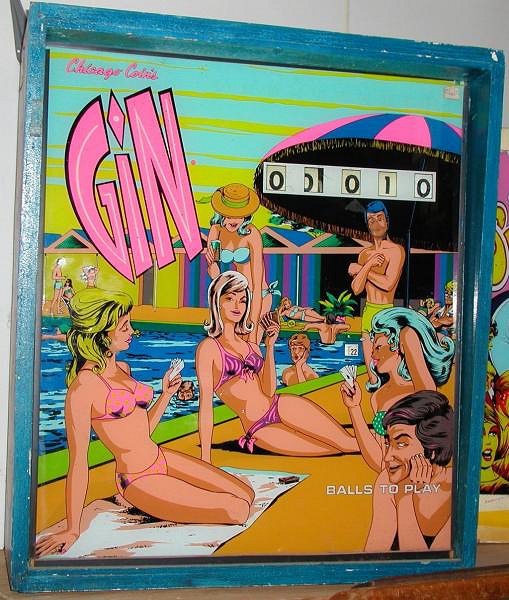
Gin, a 1970 release from Chicago Coin, serves as a colorful time capsule of the late-EM era, blending high-stakes card themes with the leisure-soaked aesthetic of poolside summer days. Designed by the collaborative trio of Albin Peters, Jerry Koci, and Wendell McAdams, the playfield is a classic layout that prioritizes steady, rhythmic action over the frantic complexity of modern machines. With its signature Christian Marche artwork—famed for its distinctively stylized characters—the machine leans heavily into a playful, sun-drenched vibe that feels like a trip to a retro resort.
Mechanically, the game relies on a straightforward but engaging toolkit: two flippers, a pair of pop bumpers, and two kick-out holes that demand precision to keep the ball in play. The five drop targets act as the primary objective, challenging the player to clear the field while navigating the four rollover buttons scattered across the playfield. It is a quintessential one-player experience that relies on the satisfying click of mechanical reels and the tactile response of traditional EM components.
For those looking to master the table, success lies in managing the drop target bank while utilizing the kick-out holes to reset your momentum. Because the game lacks the deep rulesets of modern digital machines, the strategy is purely about ball control and consistency. It is a charming example of Chicago Coin’s ability to turn a simple card-game concept into a compelling tabletop challenge, proving that sometimes all you need for a great session is a pair of flippers and a well-placed target bank.