
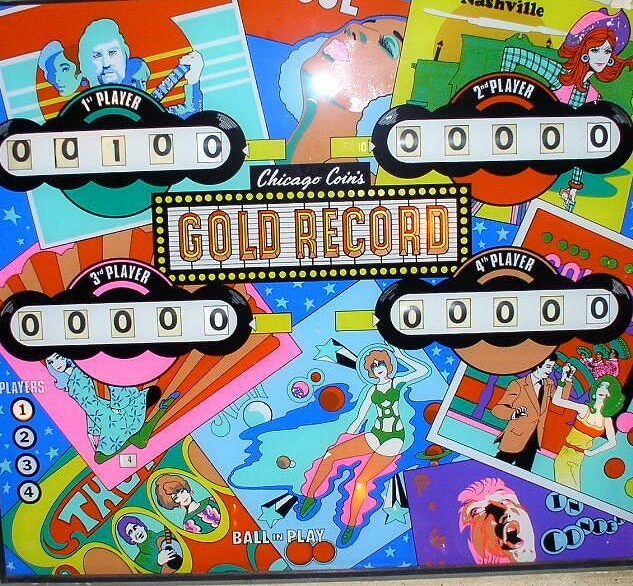
Gold Record, released by Chicago Coin in 1970, serves as a quintessential time capsule of the late-EM era, capturing the glitz of show business and the high-energy aesthetic of the music industry. Designed by the collaborative team of Albin Peters, Jerry Koci, and Wendell McAdams, the cabinet features the unmistakable, stylized art of Christian Marche, whose work provides the game with a distinct, punchy visual identity that feels plucked straight from a television variety hour. It is a four-player machine that leans into the classic mechanical satisfaction of the period, utilizing traditional reel displays to track the escalating scores of competing players.
The playfield layout is a masterclass in mid-century minimalism, centering on a five-bank of drop targets that demands precision to clear. Flanked by three pop bumpers and a trio of slingshots, the ball action is frantic and requires a steady hand to navigate the board. For those looking to dominate the scoreboard, the key is to prioritize the spinner; it is the game’s primary engine for point production, rewarding players who can maintain momentum and keep the ball dancing through the upper playfield.
While it lacks the complex multi-ball modes of modern machines, Gold Record excels in its commitment to pure, arcade-style rhythm. The inclusion of spinning posts adds a layer of unpredictable physics that keeps even seasoned players on their toes, forcing them to adapt to the ball’s trajectory as it ricochets through the target array. It is a straightforward, high-stakes experience that celebrates the simple joy of chasing a high score under the bright, painted lights of a simulated stage.