
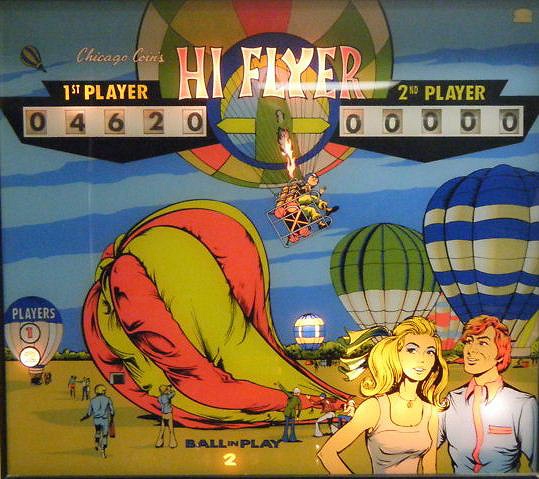
Hi-Flyer, a 1970s relic from Chicago Coin, captures the whimsical, adventurous spirit of hot air ballooning in a classic electromechanical package. Designed by the duo of Wendell McAdams and Jerry Koci with the unmistakable, high-energy illustrative style of Christian Marche, the machine eschews the gritty aesthetic of contemporary arcade games for a bright, skyward-bound theme. It is a quintessential example of the era’s design philosophy, relying on a straightforward, rhythmic layout that rewards precise timing and ball control rather than complex modern rule sets.
The playfield is anchored by a familiar but effective spread: two flippers, three pop bumpers, and a pair of slingshots that keep the ball dancing through the clouds. The primary mechanics center on a four-bank of drop targets and a spinning target, which provide the satisfying tactile feedback that defined the Chicago Coin experience. Scoring is handled by traditional mechanical reels, keeping the focus entirely on the physical interaction between the steel ball and the targets. For the player, success lies in mastering the rebound geometry of the drop targets, as clearing the bank is essential for building momentum and chasing a high score.
Though it lacks the flashy digital displays of later decades, Hi-Flyer remains a charming artifact of mid-century amusement design. The synergy between the ballooning motif and the frantic, vertical nature of the gameplay makes it a deceptively challenging machine. It serves as a reminder that before the age of deep code and multi-ball madness, the soul of a great pinball machine resided in the simple, elegant tension of keeping the ball in flight for as long as possible.