
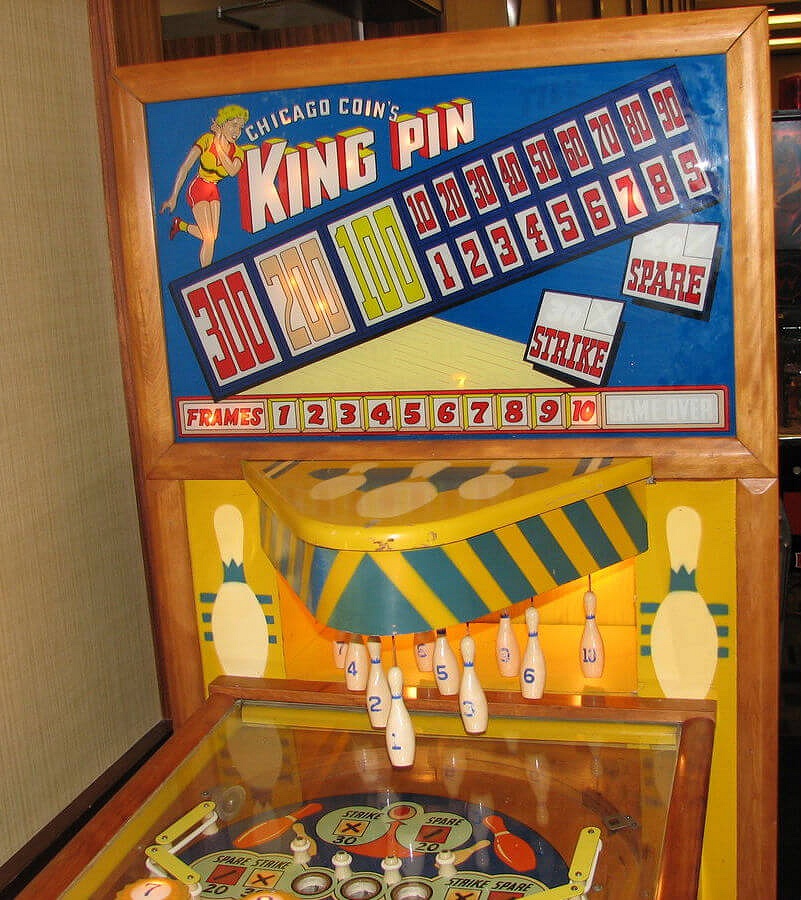
Chicago Coin’s 1962 classic, **King Pin**, is a premier example of mid-century electro-mechanical (EM) ingenuity, translating the smoky, high-stakes atmosphere of a vintage bowling alley onto a single-player playfield. Released during a golden era of arcade novelty, this table’s crowning jewel is its mechanical backbox animation. Rather than relying on a static backglass, *King Pin* engages players with a kinetic spectacle in the headbox, where physical representations of bowling pins react dynamically to the chaos on the playfield. It is a beautifully tactile feedback loop that perfectly captures the era’s obsession with mechanical showmanship, making every simulated strike feel like a genuine triumph.
Below the glass, the playfield is arranged to mimic the frantic energy of a ball crashing through a fresh rack of ten-pins. Chicago Coin packed the upper playfield with an astonishing seven active pop bumpers and two passive bumpers, creating a relentless, high-speed pinball pinball-ricochet environment. Five strategically placed kick-out holes act as high-value pockets, cradling the ball before launching it back into the bumper garden for consecutive point-scoring sequences. However, the game’s true test of skill lies in its unorthodox “reverse flippers.” Positioned in an inverted layout that points outward rather than inward, these flippers defy traditional muscle memory, turning standard ball-trapping techniques on their head.
To dominate on *King Pin*, players must completely recalibrate their flipper timing. Because the reverse flippers sweep outward, attempting to cradle or hold the ball will inevitably drain it down the center; instead, success relies on rapid, precise slaps to redirect the ball back up into the bumper nest. The ultimate goal is to keep the ball dancing among the seven pop bumpers to trigger the backbox’s pin-setting mechanisms for massive score values. For the modern collector and EM purist, *King Pin* stands as a vibrant, physics-driven monument to Chicago Coin’s creative peak—a fast-paced, challenging slice of arcade history that remains incredibly rewarding to play.