
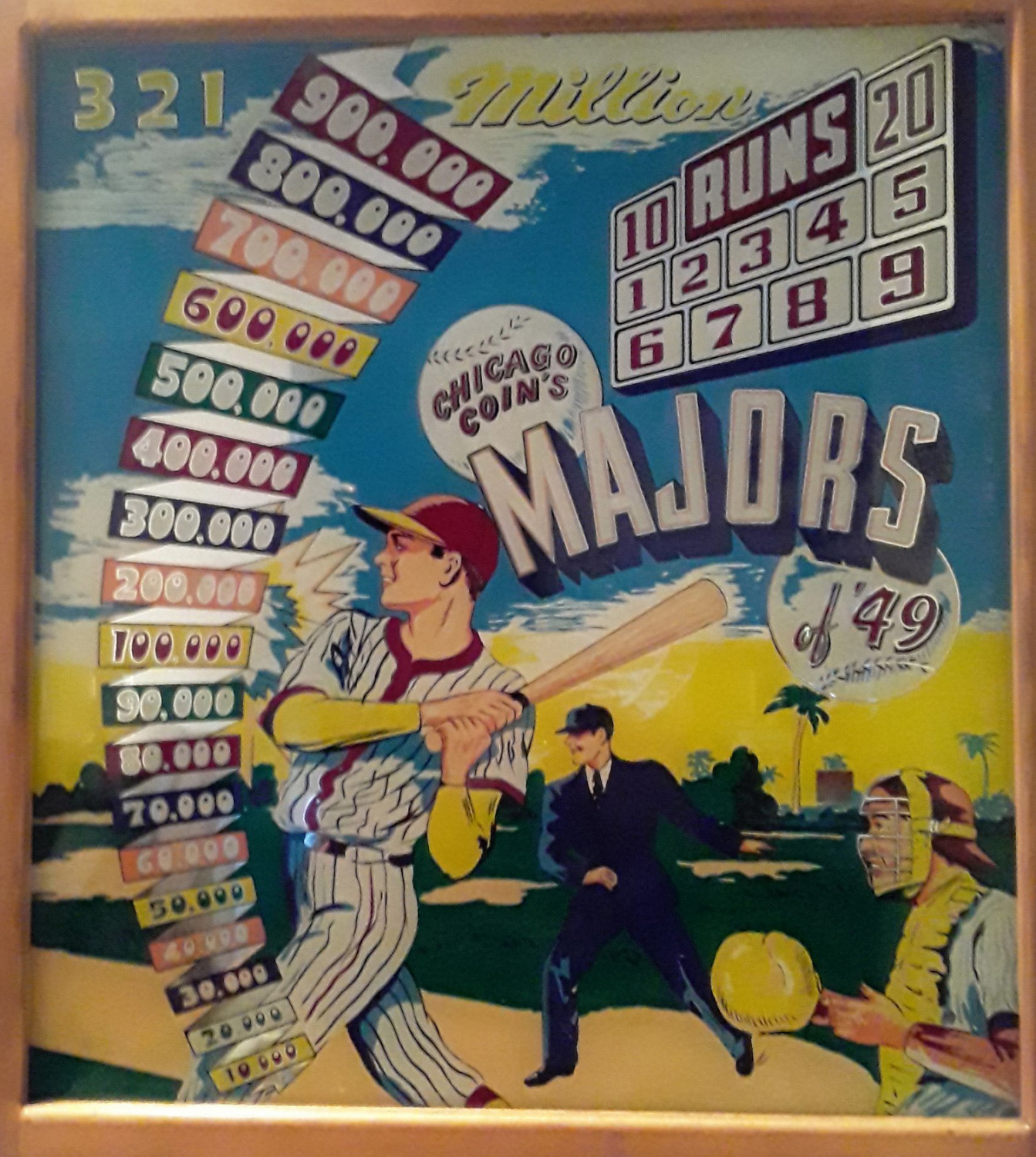
Majors of ’49 by Chicago Coin is a pristine slice of post-war electromechanical design, capturing the soaring popularity of America’s pastime on a single-player playfield. Released during a booming era for sports-themed novelty games, this machine represents Chicago Coin’s mastery of physical, kinetic feedback before the dawn of digital scoring. Rather than relying on reels or digital displays, the game utilizes a vibrant light-box backglass to track the action, turning every bumper collision and switch trigger into a suspenseful visual update as players attempt to drive runners around the illuminated bases.
At the heart of the gameplay is a beautifully straightforward proposition of the era: a single nickel buys a player five balls of high-tension mechanical action. The playfield layout translates the strategic tension of baseball into layout geometry, challenging players to steer the ball into specific lanes and targets to simulate singles, doubles, and home runs. With no modern ramps or complex subways to hide the ball, the action is entirely transparent, forcing players to focus on raw ball control and the rhythmic flow of the rolling steel to rack up runs on the backglass.
For collectors and vintage purists lucky enough to encounter one of the 1,500 confirmed units produced, mastering Majors of ’49 requires a deep appreciation for early flipper-era physics. Without the safety nets of modern game design, strategy hinges on subtle cabinet nudging and precise timing to keep the ball active in the upper playfield where the highest-scoring scoring zones lie. It stands today as a rare, tactile monument to pinball’s foundational years, proving that Chicago Coin could turn a simple five-cent investment into a grand slam of arcade tension.