
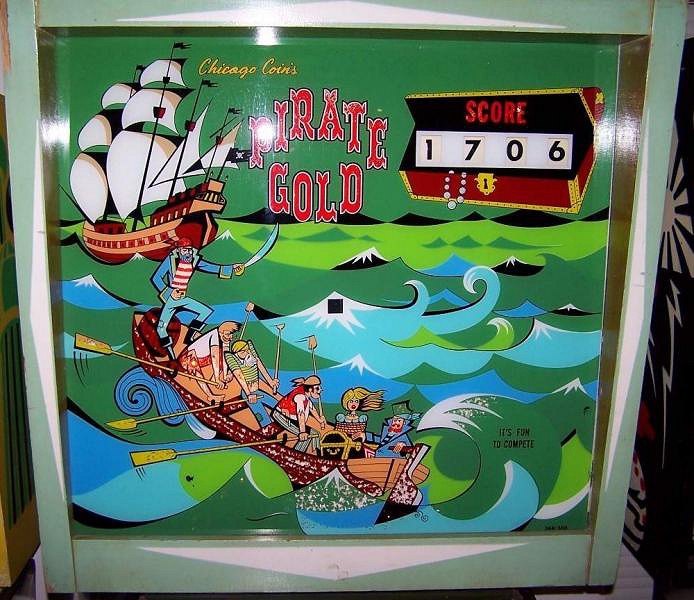
Pirate Gold, released by Chicago Coin in the mid-1970s, stands as a quintessential Electromechanical (EM) relic that captures the swashbuckling spirit of the era. Crafted by the design triumvirate of Al Schlappa, Jerry Koci, and John Gore, the machine leans into a classic nautical aesthetic brought to life by the distinct, high-energy illustrative style of Christian Marche. Unlike the gadget-heavy machines of later decades, Pirate Gold relies on the satisfying, tactile feedback of relays and spinning score reels, delivering a raw, rhythmic experience that demands precision over spectacle.
The mechanical layout is deceptively simple, centered around a pair of responsive flippers that must navigate the ball through a trio of pop bumpers and a classic horseshoe lane. With two strategically placed kick-out holes providing the primary path to high-score glory, the game forces players to master the art of the controlled shot rather than relying on modern ball-save mechanics. The layout is all about momentum; the horseshoe lane acts as a high-stakes channel that keeps the tension high, requiring steady nerves to avoid an early drain while chasing the elusive treasure of a high-score replay.
For those looking to conquer this vintage title, success lies in playing the geometry of the playfield rather than brute force. The kick-out holes are your best friends for point accumulation, but they are unforgiving if approached from the wrong angle. Mastering the timing of the flipper bats to feed the ball consistently into the horseshoe lane is the hallmark of a seasoned player on this deck. Pirate Gold remains a masterclass in minimalist design, proving that a handful of well-placed targets and a bit of sea-faring charm are all you need to keep a player hooked for hours.