
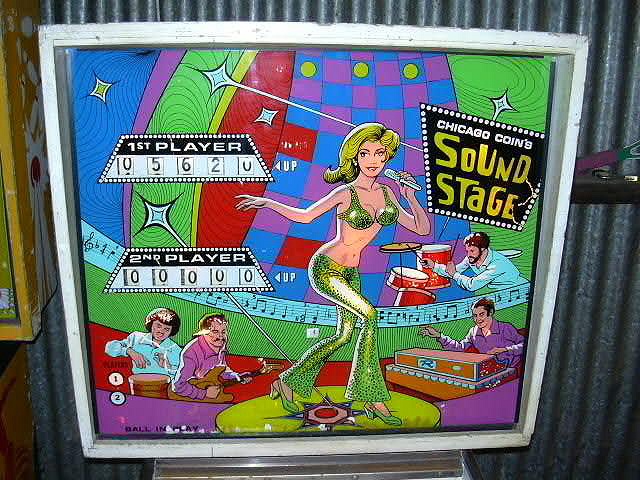
Sound Stage, released by Chicago Coin in 1974, stands as a quintessential artifact of the mid-70s electromechanical era. Designed by the collaborative team of Albin Peters, Jerry Koci, and Wendell McAdams, this two-player machine captures the simple, rhythmic joy of the era’s music-themed cabinets. Despite its modest footprint, the playfield is packed with classic EM architecture, utilizing a straightforward two-flipper layout that demands precision over the chaotic multi-ball frenzy seen in later decades.
The mechanical heart of Sound Stage relies on its eight standup targets and a series of rollover buttons to build points, punctuated by the satisfying, tactile “thwack” of the slingshots and pop bumpers. The inclusion of a singular kick-out hole adds a necessary layer of tactical risk, acting as a focal point for players looking to boost their scores through accurate shooting. With a production run of 3,000 units, the machine was a staple of its time, offering a reliable, high-energy experience that prioritized the classic “just one more game” loop.
For those approaching this vintage piece today, success lies in mastering the geometry of the two-flipper system. Because the scoring relies heavily on navigating the playfield via the rollover buttons and strategically hitting the standup target banks, players should focus on controlling the ball at the flipper tips rather than relying on desperate, wide-open shots. It is a game of rhythm and timing, rewarding those who can maintain a steady flow through the center of the playfield while avoiding the dangerous rebounds off the pop bumpers that often threaten to drain a ball down the outlanes.