
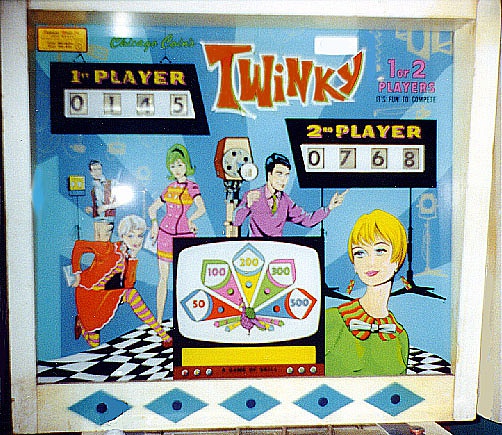
Twinky, released by Chicago Coin in the mid-1970s, serves as a quintessential time capsule of the era’s television-inspired aesthetic. Featuring the unmistakable, whimsical art style of Christian Marche, the machine leans into a lighthearted, modeling-themed presentation that captures the charm of mid-century broadcast culture. While it lacks the complex mechanical density of modern digital-age pins, its layout is a masterclass in classic EM geometry, utilizing a symmetrical arrangement of two flippers, three pop bumpers, and a pair of slingshots to keep the action frantic and unpredictable.
The gameplay experience is defined by its simplicity and the tactile satisfaction of its electromechanical reels, which click and clatter with every scoring success. A pair of kick-out holes and two rollunders serve as the primary targets, forcing players to navigate the playfield with precision rather than brute force. Marche’s vibrant, stylized artwork gives the machine a distinct personality, making it a standout visual piece for any collector who appreciates the transition period of pinball design where the focus remained squarely on pure, rhythmic ball control.
For those looking to master this two-player cabinet, the key lies in managing the tempo of the pop bumpers to feed the kick-out holes effectively. Because the table lacks the “save” features of modern pins, the strategy is purely defensive: focus on controlling the ball off the slingshots to avoid the dreaded center drain. It is an unassuming, stripped-back experience that rewards a steady hand and serves as a sharp reminder of how Chicago Coin once squeezed immense replayability out of a handful of basic mechanical targets.