
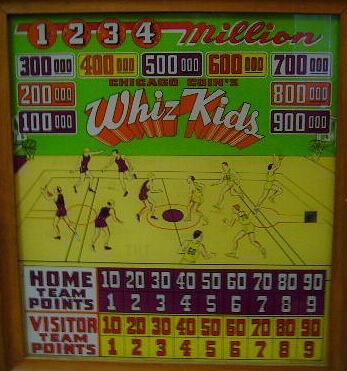
Whiz Kids, released by Chicago Coin in 1964, stands as a quintessential relic of the mid-century electromechanical era, capturing the frantic energy of the basketball court within a compact, skill-based playfield. Designed by the collaborative team of Jerry Koci, John Gore, and Al Schlappa, this single-player machine strips away the complexity of modern digital displays in favor of a vibrant, light-based scoring system. The cabinet serves as a time capsule, reflecting the simplistic, high-speed charm of sports-themed arcade games where the goal was as much about physical dexterity as it was about racking up points on the backbox.
The mechanical layout is surprisingly dense for its footprint, anchored by a pair of responsive flippers and a singular, high-tension pop bumper that dictates the flow of the ball. To simulate the “whiz” of the hardwood, the designers implemented a clever array of seven passive bumpers, which act as defensive obstacles, forcing players to navigate the ball carefully toward the kick-out hole. Two captive balls are integrated into the playfield, providing that satisfying, percussive “thwack” that defines the tactile experience of vintage Chicago Coin hardware.
For the modern collector or tournament player, the strategy on Whiz Kids relies heavily on controlling the rebound angles off the passive bumpers. Because the machine lacks the safety nets of modern ball-save technology, success requires a rhythmic approach to the flippers, timing shots to catch the captive balls in a way that maximizes point accumulation. It is a game of finesse rather than brute force, demanding a steady hand to keep the ball from rattling out of play—a pure, unadulterated test of mechanical precision that reminds us why basketball-themed games were a staple of the golden age of arcades.