
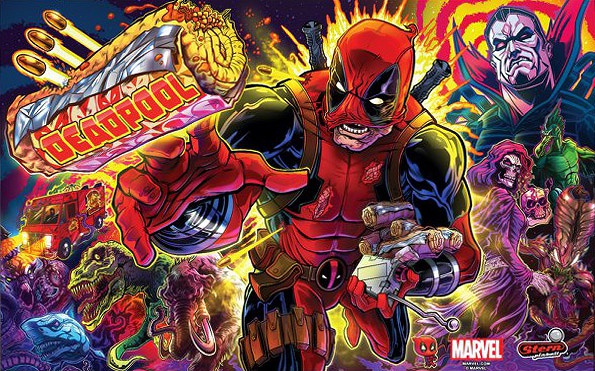
Deadpool (LE) is George Gomez’s chaotic, irreverent masterpiece for Stern, arriving in 2018 as a high-octane celebration of Marvel’s “Merc with a Mouth.” Limited to a production run of just 500 units, this machine captures the character’s manic energy through a dense, aggressive playfield layout. The design centers on the spring-articulated “L’il Deadpool” bash toy, which acts as the gateway to the game’s deeper modes. With its vibrant LCD animations and a barrage of spinning targets, pop bumpers, and drop banks, the game forces players to balance a constant stream of combat quests with the relentless pace of multiple multiball modes.
The gameplay experience is defined by its deep, interconnected systems that reward thoughtful shot selection. Mastering the table requires juggling “Chimichanga” progress, weapon collection, and team-up recruiting—bringing in allies like Wolverine or Colossus to buff your performance during boss battles. For the competitive player, the path to high scores often runs through the left flipper’s “Snikt” target, which boosts playfield multipliers, or by executing the precise right orbit-to-Katana ramp combo to trigger the “Ninjapocalypse.” Whether you are chasing the high-scoring “Disco Multiball” via the left spinner or grinding out weapon counts to earn extra balls, the game demands a high-speed, tactical approach that mirrors Deadpool’s own unpredictable combat style.
Gomez and his team succeeded in creating a machine that feels as subversive as the source material, balancing deep rules with accessible, comic-book-inspired fun. The software, penned by legends like Tanio Klyce and Tim Sexton, ensures that every shot feels consequential, from the D-E-A-D-P-O-O-L drop targets that relight battles to the complex interactions hidden behind the game’s various multiball triggers. For those lucky enough to track down one of these 500 LEs, the machine offers an endless loop of satisfying, high-energy play that remains a staple of the modern Stern era.