
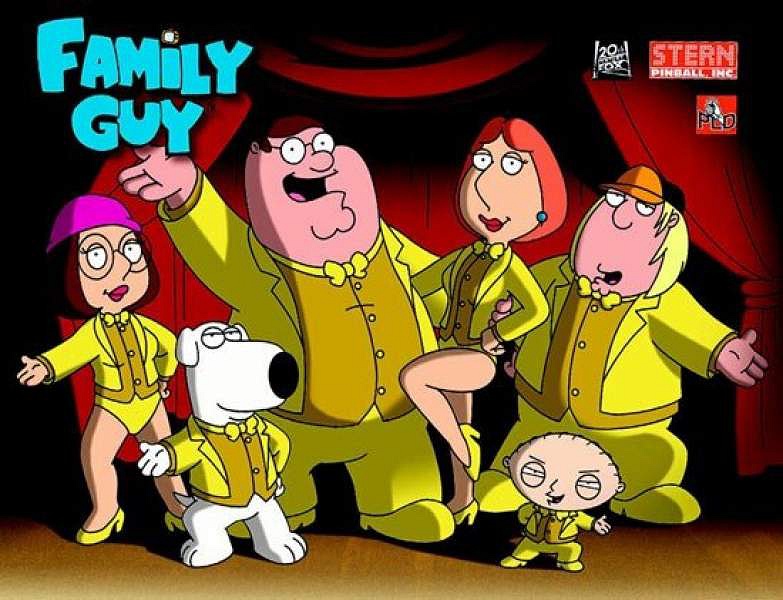
Freakin’ sweet — Stern’s 2007 Family Guy is Pat Lawlor doing what Pat Lawlor does best: hiding a genuinely deep, rewarding ruleset behind a riotous licensed theme. The playfield is packed with character figures — Peter, Lois, Meg, Chris, Stewie, and Brian — with a rotating Stewie who turns to face his own little pinball machine and a Meg who bobs up and down. Five flippers, captive balls, Newton balls, a spinner, and a full mini-playfield make this one of the busier, more ambitious layouts of its moment.
The strategy runs deeper than the crude humor suggests. Completing the drop-target bank a set number of times starts a multiball, and there’s a friendly catch-up rule built in: a low score heading into ball three usually lights the beer-can shot for a multiball to get you back in it. The right-orbit Lois spinner lights your modes, and with “TV” lit, the scoop beside the captive ball starts one. Bashing the captive balls to spell PINBALL opens the mini-playfield, where finishing every shot launches a multiball, while the Stewie pinball mode hands you a long ball-saver to focus on the mini-field and ignore drains. The wizard chase is the prize: complete all the TV modes to light TV Wizard, and since mode shots feed its jackpots, don’t time them all out — and beyond even that lies the infamous Sperm Attack finale.
Family Guy is proof that a great designer can smuggle real depth into a cartoon, and the disciplined player who learns its layered modes and multiballs is richly rewarded. Ride the spinner, conquer the mini-playfield, and chase that wizard mode. Giggity.