
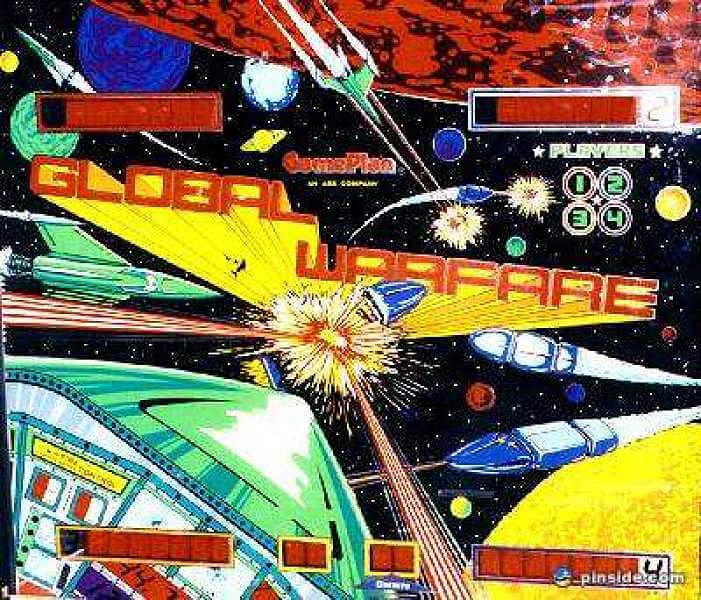
Global Warfare, manufactured by Game Plan, is an exceptionally rare solid-state relic designed by the legendary Roger Sharpe alongside Ed Cebula, featuring art by John Trudeau. Despite its militaristic title, this four-player machine actually rockets players into the cosmos with a vibrant outer space theme. With a confirmed production run of a mere ten units, it stands as one of the ultimate “holy grail” curiosities for collectors of early solid-state oddities, representing a fleeting moment when Game Plan attempted to challenge the industry’s titans with sophisticated, designer-led concepts.
The machine utilizes an early alphanumeric display system to track the interstellar conflict, offering a stark, futuristic contrast to the mechanical reels of the previous decade. John Trudeau’s artwork defines the cabinet and playfield, translating the “Global Warfare” concept into a cosmic theater of war long before he became a household name for his own playfield designs at Gottlieb and Williams. Sharpe and Cebula’s layout reflects the tactical, precision-oriented geometry of early 1980s solid-state design, where ball control, drop-target sweep strategy, and risk-reward shots took precedence over modern ramp flow.
Because so few of these machines were ever produced, finding one in the wild is a near-impossible feat, making any opportunity to play it a historic event. Players lucky enough to step up to its flippers should focus on classic solid-state fundamentals: prioritizing bonus multipliers, mastering the bounce of Game Plan’s distinct flipper assemblies, and keeping the ball alive in a unforgivingly wide-open playfield. Ultimately, Global Warfare remains a fascinating “what-if” in pinball history—a beautifully illustrated, space-age battleground that vanished almost as quickly as a shooting star.