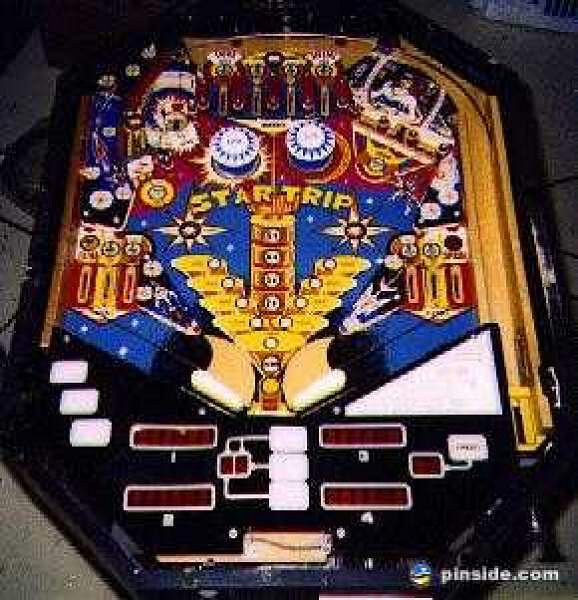
Star Trip, released by Game Plan in 1979, is a quintessential piece of late-seventies arcade history that trades the traditional upright cabinet for a sleek, social cocktail table format. Designed by Ed Cebula with cosmic-themed artwork by Dick White, this machine invites players to gather around its glass top, turning a standard game of pinball into an intimate, tabletop experience. Despite its compact footprint, the playfield is packed with a robust variety of mechanical elements, including a spinning target that demands precision and a trio of drop targets designed to test the player’s nerves as they navigate the star-filled layout.
The gameplay is anchored by a classic set of features that prioritize flow and accuracy, utilizing a pair of flippers to control the action through a network of dual inlanes. The playfield is punctuated by two pop bumpers and three slingshots, creating a frantic, reactive environment that feels surprisingly spacious given the cocktail form factor. A strategic kick-out hole provides a reliable target for point-building, while the four star rollovers reward players who can master the nudging and trajectory control necessary to navigate the table’s unique geometry.
For those looking to master Star Trip, the key lies in managing the ball’s momentum around the spinning target to maximize point accumulation from the drop target bank. Because the cocktail design alters the player’s perspective compared to a standard upright machine, the game rewards a steady hand and a focus on the ball’s path through the star rollovers rather than relying solely on reflex. It remains a fascinating curiosity for collectors—a time capsule of an era when Game Plan was experimenting with the very way we interact with pinball cabinets.