
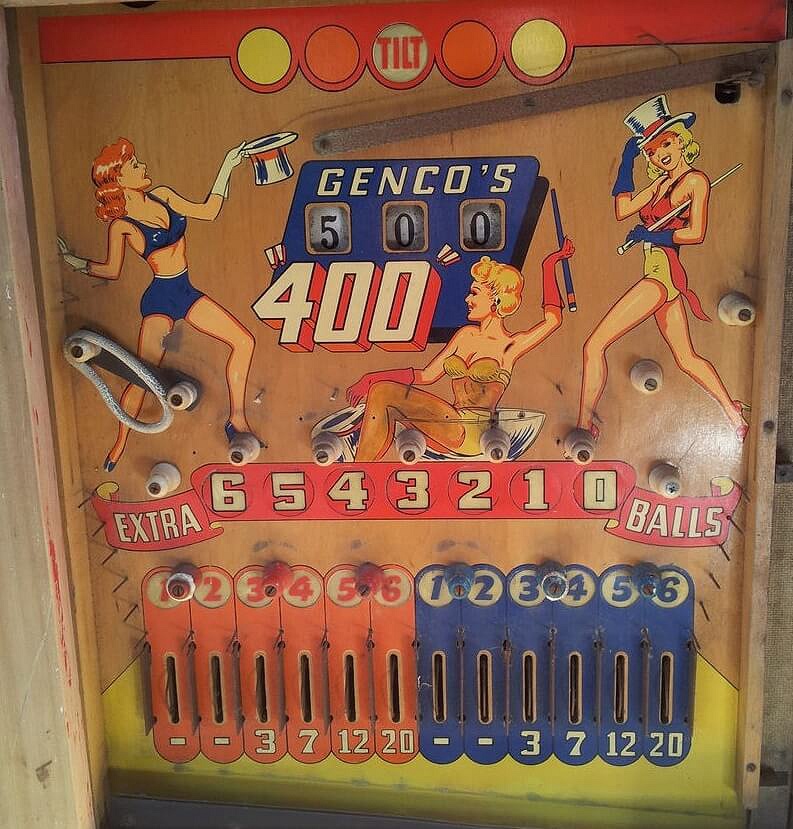
Here’s a true deep-cut relic for the historians — 400, an electromechanical single-player from Genco, one of the pioneering names from the earliest days of the coin-operated amusement industry. Credited to designer Harvey Heiss, it’s a genuine antique, a machine from the formative era when the ground rules of the game were still being invented and companies like Genco helped lay the foundation for everything that came after.
The available details on this one are sparse, as they often are for the oldest machines — what we know is that it offered the classic arcade proposition of six balls for a single coin, that irresistible bit of value that lured players to the glass generation after generation. Genco was an important early manufacturer, active in the decades when pinball was transforming from a simple bagatelle into the flipper-driven game we know, and machines bearing its name are prized by collectors who treasure the industry’s earliest chapters. This is pinball history in its rawest, most elemental form.
For the serious collector and historian, 400 is the kind of obscure early artifact that connects the modern game to its distant origins. Documentation is thin and survivors are scarce, which only adds to the intrigue for those who love chasing the hobby’s forgotten corners. It’s a reminder that pinball’s story stretches back much further than the famous solid-state and DMD eras, into a pioneering age of experimentation and mechanical ingenuity. A machine like this is less about deep strategy and more about reverence for where it all began. For that alone, this Genco rarity earns its place in the story. (Note: available data on this title is very limited.)