
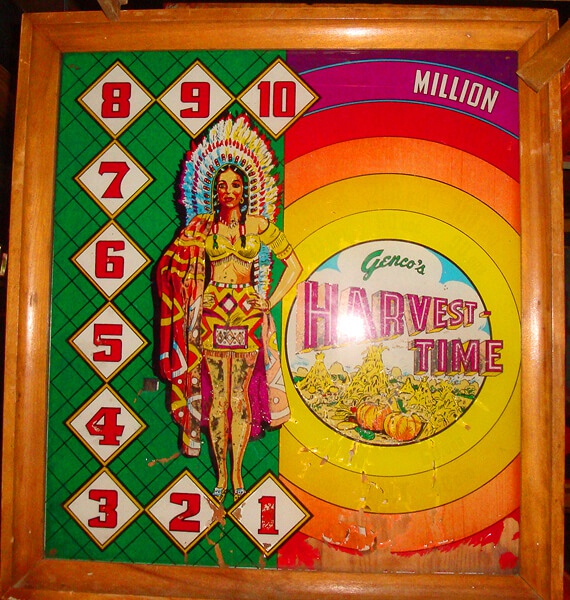
Harvest Time, released by Genco in 1952, serves as a quintessential example of early-fifties electro-mechanical design. While the era was often defined by complex innovations, this title leans into the simplicity of its Native American theme, offering a focused, single-player experience that relies on precision rather than spectacle. With a modest production run of just over 1,100 units, it stands as a charming relic for collectors who appreciate the tactile, no-nonsense gameplay of the post-war transition period.
The playfield is stripped-back and intentional, utilizing a classic two-flipper layout anchored by a single pop bumper. The mechanical challenge is dictated by three strategically placed kick-out holes, which serve as the primary scoring hubs for the player. Because the machine lacks the modern digital complexity of later decades, success here relies on mastering the raw momentum of the ball as it carves through the playfield. It is a game of patience and rhythm, requiring the player to navigate the board’s geometry to repeatedly find those rewarding kick-out pockets.
Despite its age, Harvest Time captures the spirit of Genco’s mid-century aesthetic, where light-based scoring displays provided all the feedback a player needed. It remains a fascinating study in minimalist design, proving that even with a limited set of physical toys, an EM machine can offer a compelling test of skill. For the modern enthusiast, this machine is less about flashing lights and deep rulesets and more about the fundamental satisfaction of controlling the ball in a vintage, analog environment.