
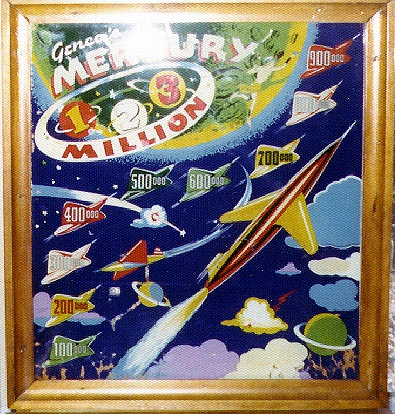
Mercury, a 1954 release from Genco, stands as a fascinating relic of the early Space Age, crafted by designer Harvey Heiss during an era when pinball was rapidly transitioning from woodrail simplicity to the more kinetic gameplay of the mid-fifties. With a production run of fewer than 750 units, it is a rare find that captures the mid-century obsession with the cosmos. Unlike the complex, multi-tiered machines of the modern era, Mercury relies on a stripped-back, aggressive architecture that prioritizes precision and the thrill of the hunt over elaborate rule sets.
The playfield is a dense network of ten kick-out holes, creating a “target-rich” environment that forces players to carefully navigate the ball through a gauntlet of scoring opportunities. Anchored by a solitary pop bumper, the game demands a rhythmic, deliberate style of play; because the machine lacks the safety nets of modern outlane ball-savers, every shot into a kick-out hole is a high-stakes gamble. The space-themed aesthetic serves as a perfect backdrop for this frantic, hole-heavy design, where the primary objective is to maintain ball control long enough to capitalize on the dispersed scoring clusters scattered across the board.
For those tracking down this vintage piece, the strategy is remarkably straightforward yet deceptively difficult: mastering the geometry of the flippers is non-negotiable. Because the kick-out holes act as both scoring targets and potential traps, players must balance the pursuit of high-value pockets with the need to avoid the inevitable “drain-out” that follows a poor return. Mercury is less about deep narrative progression and more about the visceral, tactile satisfaction of hitting your marks in a machine that feels like a classic piece of arcade history.