
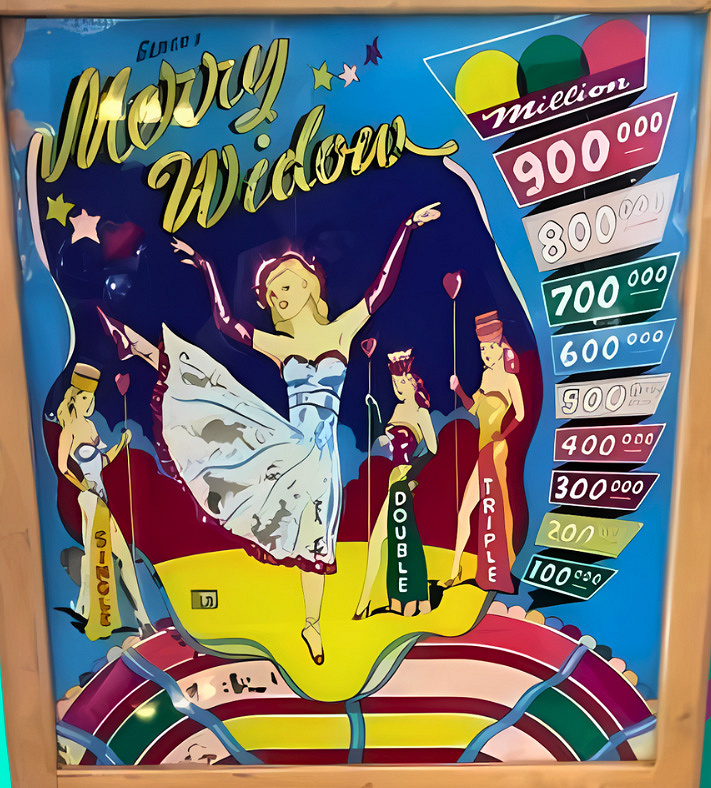
Merry Widow, released by Genco in 1952, stands as a quintessential artifact of the early post-war era, capturing the elegance of ballroom pageantry and the classic aesthetic of mid-century amusement. As a single-player electromechanical machine, it eschews the complexity of modern multi-ball mayhem in favor of the rhythmic, precision-based gameplay that defined the transition into the flipper age. The playfield is a study in vintage minimalism, dominated by six passive bumpers that act as chaotic navigational hazards, forcing players to rely on steady aim rather than brute force.
The mechanical heart of the machine lies in its trio of kick-out holes, which serve as the primary scoring engines. Mastering the layout requires a delicate touch to navigate the ball into these pockets, effectively turning the playfield into a test of gravity and timing. With its thematic focus on dance and the grace of the waltz, the machine demands a certain finesse from the player; there is no reliance on high-tech gimmicks or motorized toys here, only the tactile satisfaction of a well-placed shot and the rhythmic clatter of the score reels.
While only around 1,600 units were produced, Merry Widow remains a prized piece for collectors who appreciate the purity of early Genco design. Because the table lacks the frantic pace of modern machines, success hinges on understanding the predictable bounce patterns created by the passive bumpers. Players looking to maximize their score should prioritize controlling the ball’s trajectory toward the kick-out holes, as these are the keys to unlocking the board’s scoring potential. It is a charming, understated machine that invites the player to slow down and appreciate the golden age of arcade pageantry.