
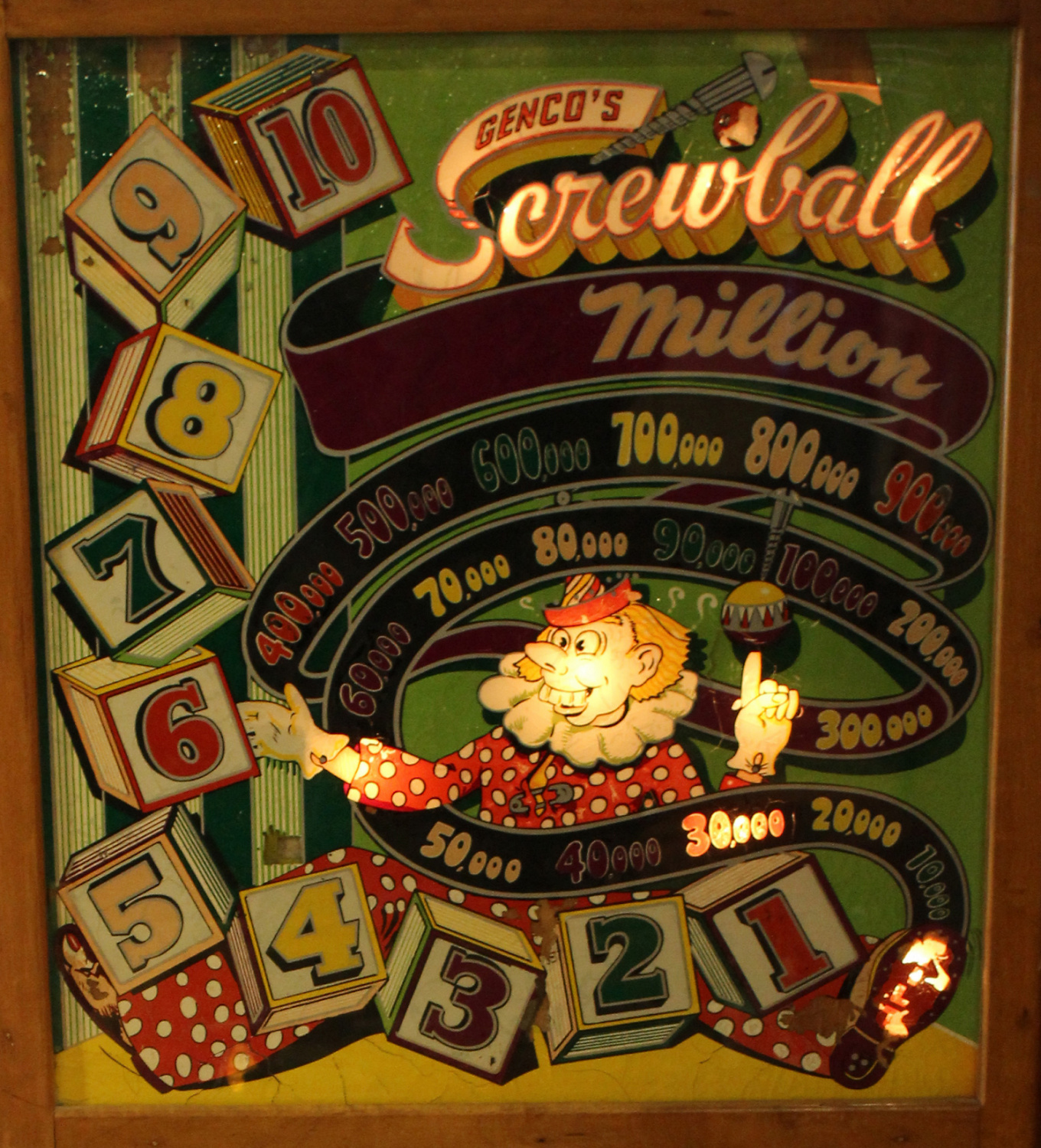
Screwball, released by Genco in 1948, serves as a quintessential artifact of the early post-war era, capturing the whimsical, slightly unsettling aesthetic of mid-century circus culture. Designed by Harvey Heiss with the unmistakable, vibrant illustrative style of Roy Parker, this single-player electromechanical machine leans hard into its clown theme. It eschews the complex ramps and magnets of modern manufacturing for a focused, high-tension experience centered on the playfield’s geometry rather than cinematic spectacle.
The mechanical heart of Screwball relies on a minimalist but challenging layout, featuring two flippers and a strategic array of three kick-out holes. Success on this table demands precision; players must navigate the five rollover buttons that dot the field, essentially turning the playfield into a test of ball control and timing. The inclusion of a time clock adds a layer of urgency to the proceedings, forcing players to make quick decisions before their window of opportunity slams shut.
With nearly 3,500 units produced, Screwball was a significant presence in its day, offering a pure, stripped-back experience that highlights the transition from the bagatelle-style games of the past to the flipper-driven era. While it lacks the deep rulesets or digital displays of modern machines, its charm lies in its simplicity and the tactile satisfaction of landing the ball into the kick-out holes under the watchful, painted gaze of Parker’s clowns. It is a vital piece of history for anyone interested in the foundational mechanics of the hobby.