
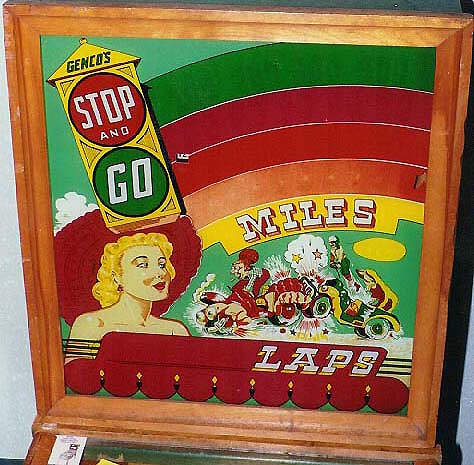
Stop and Go, a 1947 release from Genco, captures the nascent excitement of post-war auto racing in a compact, electromechanical package. Designed during an era when pinball was stripping away the clutter of bagatelle-style boards, this machine relies on the essential geometry of the game. With iconic artwork by Roy Parker—a name synonymous with the golden age of arcade aesthetics—the table serves as a time capsule of mid-century design, offering a raw, tactile experience that predates the complex rule sets of the modern era.
The mechanical layout is deceptively sparse, featuring just two flippers and a solitary pop bumper to dictate the flow of play. In an age before digital displays, the game communicates through classic light-based scoring, demanding that the player focus entirely on ball control and timing. Because the playfield is stripped down to its barest components, every nudge and strike carries significant weight, forcing the player to master the physics of the ball rather than chasing complex modes.
For the vintage enthusiast, Stop and Go represents a rare find, with only about 862 units produced. It is a masterclass in minimalism; without the distraction of ramps or deep software, success hinges on your ability to predict the erratic rebound patterns off that single pop bumper. It is a quintessential piece of arcade history that rewards the patient player who appreciates the pure, unadulterated tension of an early EM machine.