
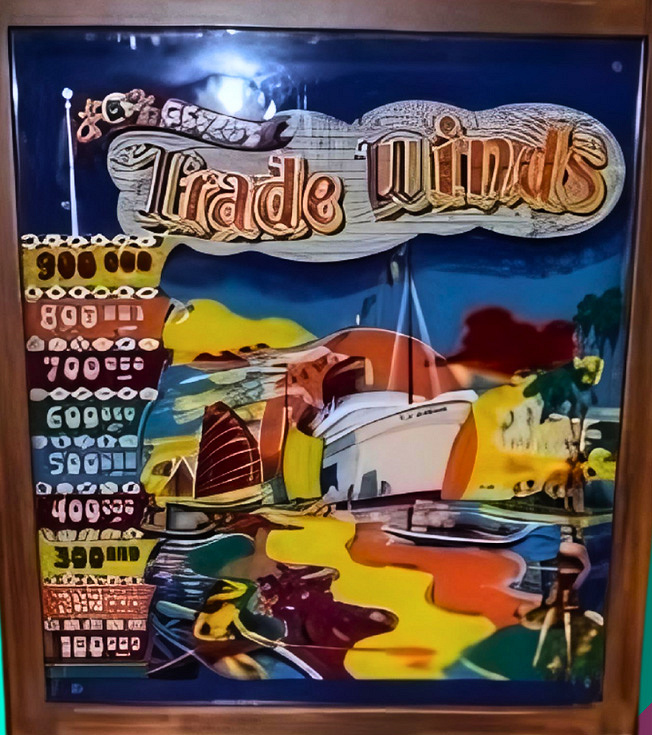
Trade Winds, released by Genco in 1954, stands as a quintessential artifact of the early post-war electromechanical era, capturing the romanticism of high-seas adventure through a nautical lens. With a limited production run of just over 2,500 units, this single-player machine eschews the complexity of modern ramps and magnets for a pure, raw experience centered on navigation and precision. The playfield is densely populated with nine passive bumpers, forcing players to navigate the ball through a chaotic, rebounding sea rather than relying on the controlled flow of later designs.
The defining mechanical signature of the machine is its six “floating” rollover buttons, which challenge the player to tactically trigger specific sequences while maneuvering around the static bumpers. A singular kick-out hole serves as the primary goal-scoring objective, demanding a delicate touch to ensure the ball finds its mark amidst the unpredictable ricochets. As a quintessential Genco design, Trade Winds prioritizes rhythmic, high-tension gameplay that rewards the steady hand of a sailor rather than the frantic reflex of a modern arcade gamer. It remains a fascinating study in minimalist design, proving that even with basic hardware, the thrill of the hunt remains the heartbeat of the pinball experience.