
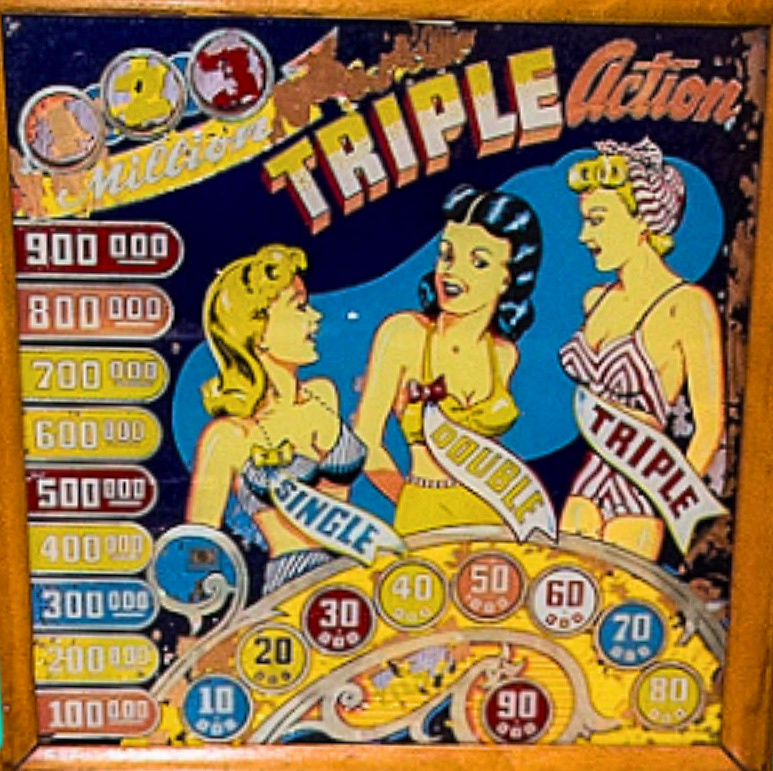
Triple Action, released by Genco in 1948, stands as a pivotal artifact in the evolution of arcade history, representing the masterful touch of legendary designer Steve Kordek. Stepping away from the chaotic, feature-light playfields of the late 1940s, Kordek utilized this machine to refine the player experience, centering the action around a pair of flippers—a revolutionary inclusion that had only just been introduced to the industry. With a theme centered on the classic “pin-up” aesthetic common to the era, the machine feels like a window into the golden age of mid-century amusement, relying on a dense forest of twelve passive bumpers to keep the ball in constant, unpredictable motion.
The gameplay on Triple Action is defined by its simplicity and the frantic, high-energy pace dictated by those pervasive bumpers. Rather than relying on complex ramps or modern multi-ball mechanics, the challenge here is purely spatial; players must master the timing of the flippers to navigate the ball through the crowded playfield and into the central kick-out hole. It is a game of conservation and precision, where the lack of modern digital scoring puts the focus entirely on the physical interaction between the player and the steel ball.
Though modest by today’s standards, the machine’s legacy is cemented by its historical significance and its relatively limited production run of under 3,000 units. For the modern collector, Triple Action is more than just a vintage curiosity; it is a lesson in minimalism. Successfully managing the ball through the dense bumper field requires a rhythmic, almost meditative approach to flipper control, serving as a reminder that before the era of deep rulesets and complex modes, the core thrill of pinball was simply keeping the game alive against the odds.