
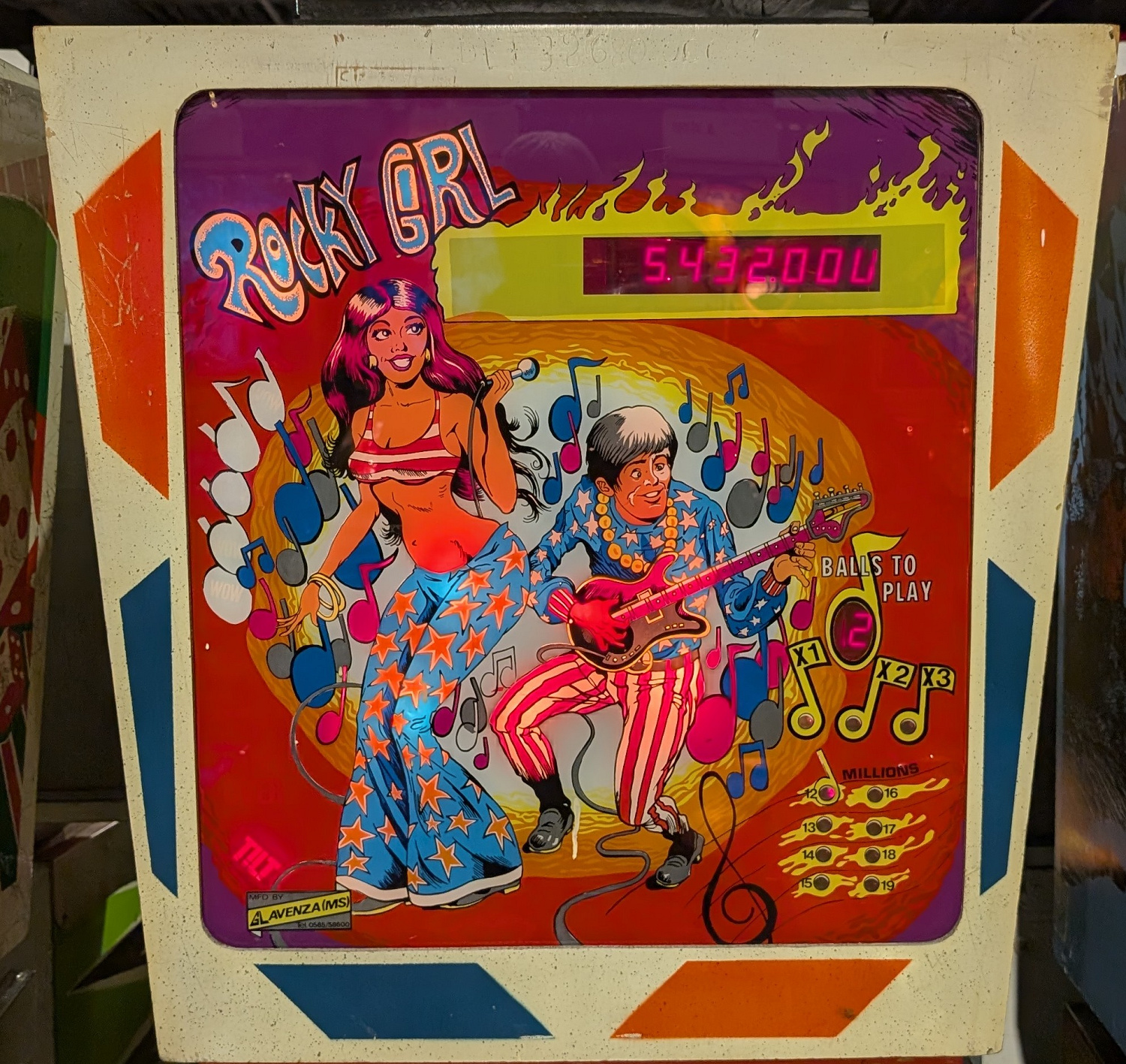
Rocky Girl, a unique Electromechanical conversion by Giuliano Lodola, stands as a curious relic of the era when independent operators breathed new life into aging cabinets. While it eschews the complexity of modern licensed themes, it leans heavily into a lighthearted musical motif, focusing on the simple, rhythmic satisfaction of an Add-a-Ball machine. The playfield is a classic, uncluttered layout dominated by three pop bumpers and a pair of slingshots, framed by nine standup targets and a dual-spinner arrangement that forces players to balance their attention across the board.
The gameplay loop is surprisingly tactical for an EM conversion, centering on the management of its two spinning targets. The right spinner functions as a modifier, shifting the scoring potential of the center spinner; savvy players will prioritize keeping that center wheel dialed to its peak 1,000-point value. Meanwhile, the playfield features a set of ABC lanes that serve as the primary objective for those chasing longevity. Completing this sequence lights the saucer for an extra ball, a crucial mechanic that transforms a standard session into a high-scoring endurance test.
Success on Rocky Girl requires a delicate touch with the playfield’s scoring quirks. The blue note targets act as a “reverse-reward” system, where their value drops significantly once lit, turning them from point-magnets into hazards you’ll want to avoid during high-stakes play. For the opening move, a precise plunge into the green-lit ABC lane is the high-value play, instantly netting 10,000 points. Though it lacks the glitz of mass-produced titles, Rocky Girl offers a charming, focused challenge that rewards precision and old-school board management.