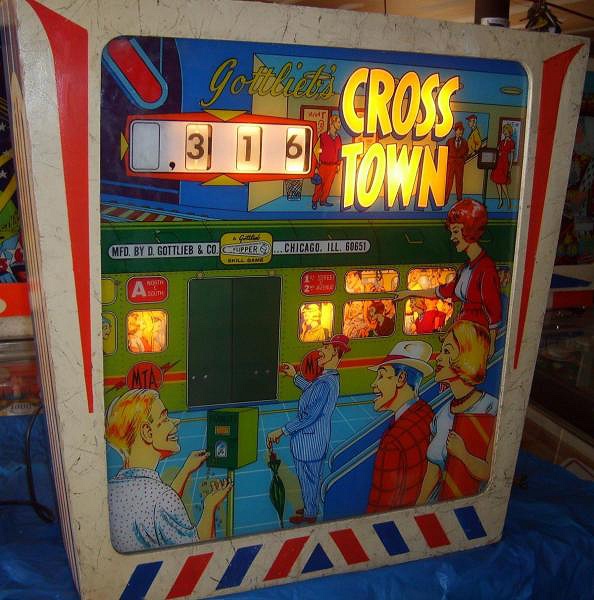
Cross Town, released by Gottlieb in 1966, stands as a quintessential example of the mid-sixties electro-mechanical era, masterfully crafted by the legendary design duo of Ed Krynski and artist Art Stenholm. Centered on the hustle and bustle of city living, the machine utilizes a two-flipper layout that demands precision over brute force. Its most striking aesthetic draw is the mechanical backbox animation, a hallmark of Gottlieb’s ambition during this period, which brings the urban theme to life through rhythmic, gear-driven movement that perfectly complements the frantic energy of the playfield.
The gameplay experience revolves around a clever color-matching mechanic located on the central playfield. Players must strategically navigate the ball to align the red and yellow lights, a task that tests patience and accuracy. Once you’ve successfully synced the illumination, the central standup target becomes the most valuable piece of real estate on the board; hitting it in this state catapults your score toward a 300-point peak, a massive payout compared to the standard 10-point pittance awarded during normal play.
With only 2,765 units produced, Cross Town is a relatively rare artifact that rewards those who can master its rhythm. Navigating the four pop bumpers and dual passive bumpers requires a steady hand, as the game’s tilt mechanism is unforgiving—trigger it, and your urban journey ends abruptly. For the vintage enthusiast, this machine offers a satisfying, high-stakes loop that forces you to balance the pressure of the city commute with the precise timing required to light up the board for those big-point payouts.