
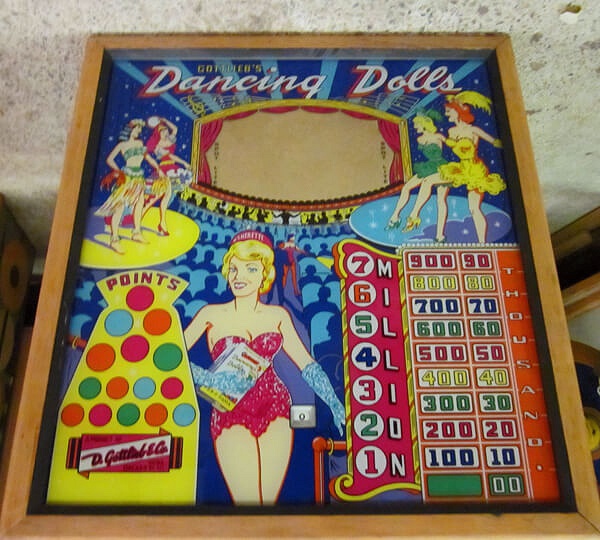
Dancing Dolls, a 1960 classic from Gottlieb, serves as a quintessential showcase of the collaborative genius between designer Wayne Neyens and legendary artist Roy Parker. This single-player EM machine captures the whimsical, mid-century aesthetic that defined the era, centered around a music and dance theme that brings a lively rhythm to the playfield. The machine is best known for its captivating mechanical backbox animation, which provides a kinetic visual payoff that perfectly complements the frantic action of the six pop bumpers and dual kick-out holes scattered across the board.
The gameplay loop centers on color-coded progression: players must strategically target the yellow and red standups or their corresponding saucers to illuminate the matching pop bumpers and saucers, effectively turning the playfield into a rhythmic light show. Managing these shots is critical, as the scoring environment demands careful navigation. While the siren call of a high-value gobble hole might tempt the unwary, veteran players know better than to sacrifice a ball for a relatively meager 250,000-point reward.
With only 1,150 units produced, Dancing Dolls remains a prized relic for collectors who appreciate the tactile, mechanical charm of early Gottlieb design. Its layout is deceptive in its simplicity, requiring precise ball control to activate the pop bumpers while avoiding the dreaded blue gobble hole. For those looking to master this vintage gem, the key lies in disciplined target selection rather than chasing low-value traps—a testament to Neyens’ ability to balance risk and reward in a purely mechanical package.