
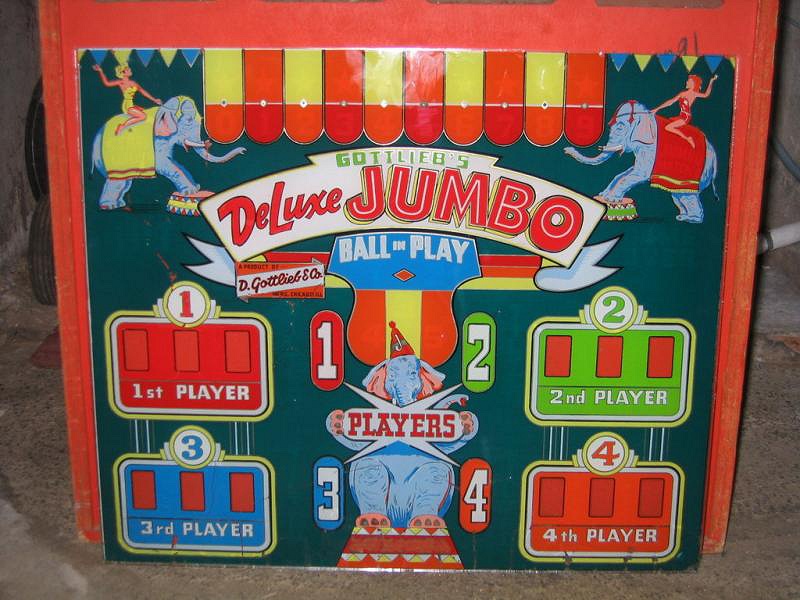
Deluxe Jumbo, Gottlieb’s 1950 Electro-Mechanical offering, is a vibrant four-player game designed by the legendary Wayne Neyens with art by Roy Parker. Emerging from an era when pinball was truly finding its voice, Deluxe Jumbo stands out for its designation as a “Novelty Play” machine, a hallmark of Gottlieb’s innovative spirit under Neyens’ guidance. This distinction suggests a playfield designed around a unique central gimmick or an unconventional scoring objective, moving beyond the simple “light all targets” formula to offer players a fresh and engaging experience. The game’s mechanical score reels click and whir, providing satisfying auditory feedback that complements the physical thud of the solenoids, a quintessential part of the EM charm.
As an EM from 1950, Deluxe Jumbo would have offered a direct, tactile gameplay experience, emphasizing shot accuracy and ball control. While specific playfield features beyond the standard flippers, bumpers, and slingshots are not detailed, the “Novelty Play” classification implies a focus on a distinctive scoring mechanism or an unusual interaction with the game’s elements. Players would likely find themselves chasing specific shot combinations or aiming for targets that activate unique scoring sequences, all contributing to the game’s singular appeal. The artistry of Roy Parker would have undoubtedly brought this novelty to life with a captivating backglass and playfield design, drawing players into its distinctive world.
Tournament strategy on a machine like Deluxe Jumbo would center on mastering its specific “Novelty Play” mechanics. Without complex rule sets or multiball modes, success hinges on consistent shot placement, understanding the game’s unique scoring opportunities, and skillful nudging to keep the ball in play and guide it towards high-value targets. Unlike modern machines with deep code, EM games reward precision and a keen understanding of the physics of the ball, making each game a test of fundamental pinball skills. Deluxe Jumbo remains a testament to Gottlieb’s early creativity, offering a glimpse into a foundational period of pinball design where innovation often meant a fresh twist on the core gameplay loop.