
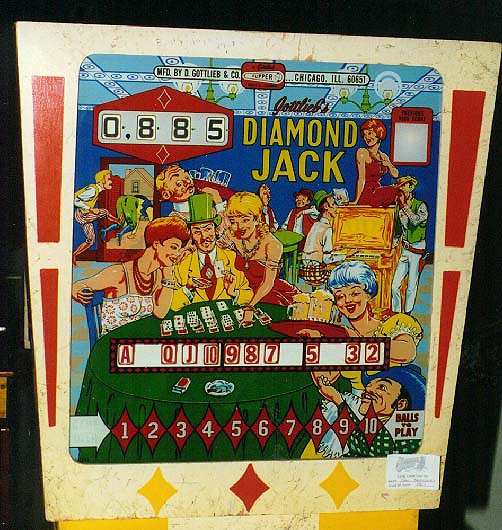
Diamond Jack, a 1967 classic from Gottlieb, stands as a quintessential example of the “add-a-ball” design philosophy that defined the era. Engineered by the legendary Ed Krynski and featuring the vibrant, card-themed aesthetic of artist Art Stenholm, this single-player EM machine captures the high-stakes tension of a casino floor within a tight, two-flipper layout. With only 650 units ever produced, it remains a sought-after relic for collectors who appreciate the tactile, mechanical satisfaction of a well-calibrated roto-target unit.
The playfield is anchored by a carousel-style roto-target featuring five spinning faces, a signature toy that demands precision. While the temptation to light up the roto-target is high, seasoned players often treat it with caution; the physics of the target are notoriously unforgiving, as center-mass strikes frequently funnel the ball straight down the middle, while off-center hits tend to ricochet aggressively toward the outlanes. Instead, a more reliable scoring strategy involves utilizing the top rollovers for consistent 50-point gains or keeping the ball trapped in the pop bumper garden, where surrounding standup targets provide a steady stream of points.
Despite its age, Diamond Jack offers a deceptively deep challenge for those looking to master vintage geometry. It is a game that rewards patience over aggression, forcing you to navigate the hazards of the roto-target while carefully managing your ball count. When you successfully navigate the board, the add-a-ball mechanic provides that quintessential Gottlieb thrill, extending your session and forcing you to decide whether to push your luck or play it safe in the bumpers. It is a lean, mean gambling machine that proves you don’t need digital displays to feel the rush of a winning hand.