
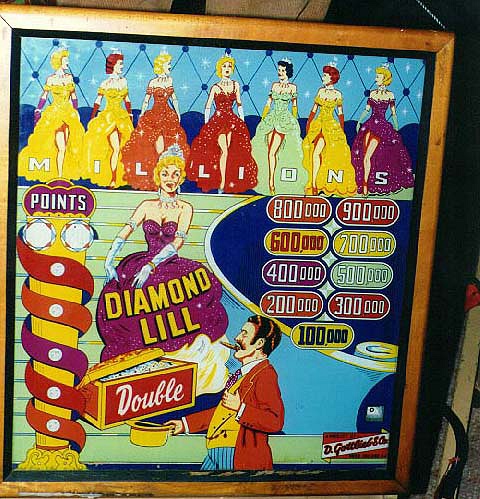
Diamond Lill, released by Gottlieb in 1954, remains a quintessential example of the “woodrail” era, showcasing the collaborative brilliance of designer Wayne Neyens and artist Roy Parker. With a production run of only 700 units, this machine is a rare artifact of mid-century arcade design, featuring a playfield layout that emphasizes precision and classic EM geometry. The board is anchored by four active pop bumpers and three passive bumpers, creating a chaotic, unpredictable dance for the ball that demands a steady hand and a quick reaction time.
The gameplay centers on a high-stakes hunt for Specials, which can be earned through three distinct paths: clearing the A-B-C-D rollover lanes to light the saucers, accumulating enough single points, or simply hitting the high-score thresholds. Points are harvested by navigating the orbit gates—which reward 50k in either direction—or by threading the center loop for a 100k payout. Players looking to maximize their score must master the art of the nudge, as the physics of these vintage machines are unforgiving; however, the operator must be wary, as a heavy hand with the cabinet will trigger a game-ending tilt.
Visually, the game embodies the whimsical charm of Roy Parker’s aesthetic, serving as a time capsule of the 1950s gaming floor. While it lacks the complex toys of modern tables, its “action ring” and dual kick-out holes provide enough mechanical variety to keep players engaged. Whether you are chasing the elusive special or simply trying to survive the erratic rebound of the bumpers, Diamond Lill offers a masterclass in the minimalist, high-tension design that defined Gottlieb’s golden age.