
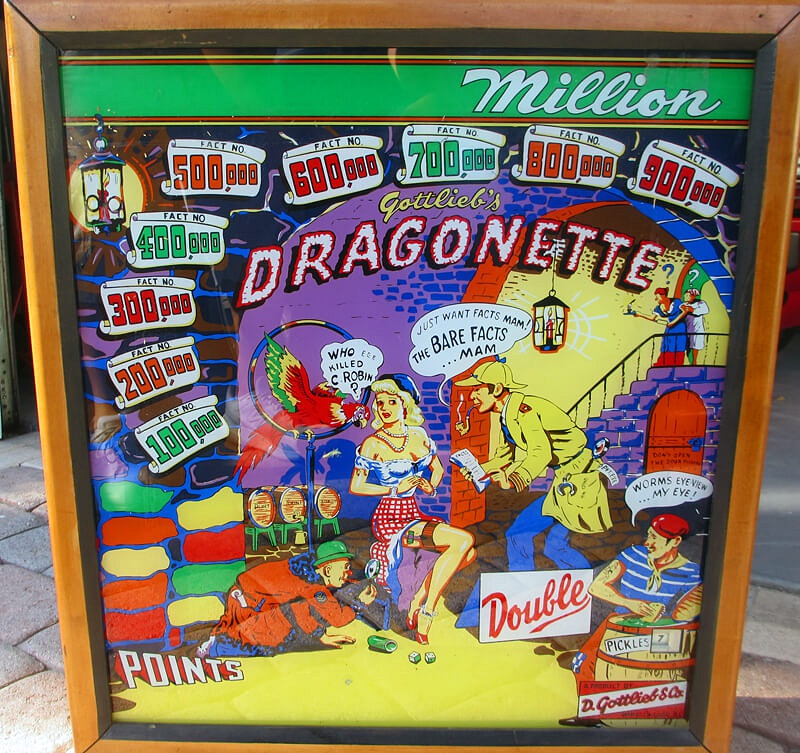
Dragonette, released in 1954, stands as a quintessential artifact of Gottlieb’s golden era, showcasing the legendary collaboration between designer Wayne Neyens and artist Roy Parker. With a light-hearted “Cops and Robbers” theme, the cabinet captures the whimsical, mid-century charm that defines early electromechanical playfields. While it lacks the frenetic pace of modern machines, its 950-unit production run makes it a coveted piece of history for collectors who appreciate the tactile, deliberate nature of 1950s pinball engineering.
The playfield layout is a masterclass in space management, eschewing complex ramps for a strategic array of five trap holes and five rollover buttons. Navigating this board requires precision, as the five pop bumpers and two slingshots act as chaotic agents, frequently redirecting the ball into one of the many scoring traps. The game demands a rhythmic, controlled approach; rather than chasing massive multiball jackpots, the player must master the subtle nudge and the timing of the two flippers to consistently land the ball in the high-value holes.
For those looking to conquer this classic, success hinges on maintaining board awareness to light the rollover buttons while carefully managing the ball’s momentum toward the traps. Since the machine relies entirely on lamp-based scoring, every shot feels like a high-stakes puzzle. Neyens’ design philosophy shines through in the way the playfield forces you to balance offensive target-seeking with defensive ball control, proving that even with a simple two-flipper setup, a machine can offer a surprisingly deep and rewarding experience.