
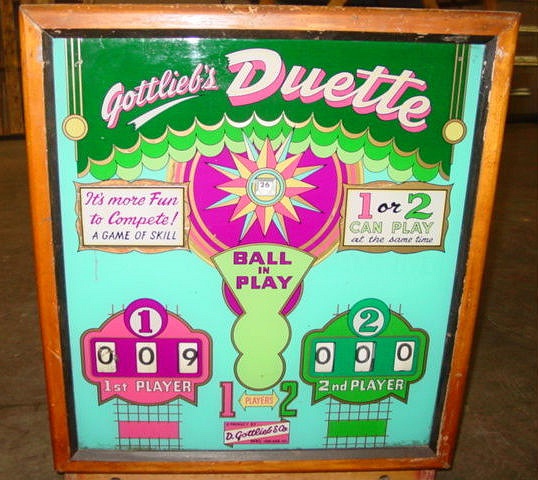
Duette, a 1955 release from Gottlieb, stands as a fascinating relic of the early electro-mechanical era, showcasing the collaborative genius of designer Wayne Neyens and artist Roy Parker. Limited to a production run of just 326 units, this two-player machine is a masterclass in minimalist design, favoring tight, tactical play over the sprawling, toy-heavy layouts of modern pins. The aesthetic is pure mid-century charm, brought to life by Parker’s iconic art style, which perfectly captures the arcade sensibilities of the mid-fifties.
The playfield layout is a curious puzzle defined by its unconventional geometry. Most notably, the machine utilizes reversed flipper placement, a design choice that forces even seasoned players to unlearn their standard timing and approach. The field is populated with a trio of active pop bumpers and four passive bumpers that act as chaotic traffic directors, while the inclusion of a classic gobble hole provides a high-stakes drain that demands careful ball control. With only two standup targets to anchor your scoring, precision is paramount; you aren’t playing for massive jackpot sequences, but for the satisfaction of navigating a board designed to punish hesitation.
For those stepping up to a Duette today, the strategy is entirely centered on managing the unpredictable nature of those passive bumpers. Because the flippers are reversed, your traditional “cradle and shoot” techniques are inverted; you’ll want to focus on early, controlled flips to avoid the gobble hole, which acts as a constant threat near the bottom of the field. It is a rare, challenging piece of history that rewards players who can master its unique, non-standard ergonomics. If you encounter one in the wild, treat it as a lesson in the fundamental physics of the game—it remains one of the most distinct mechanical challenges in the Gottlieb catalog.