
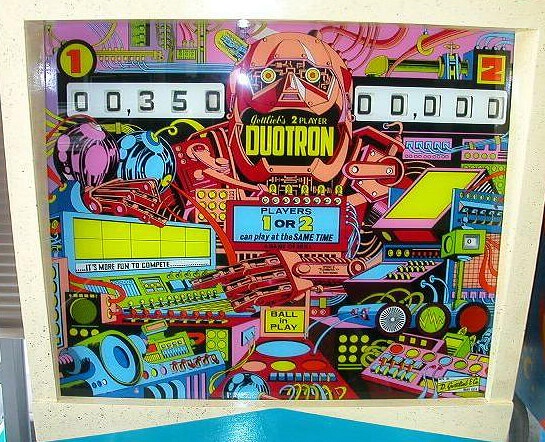
Duotron, released by Gottlieb in 1974, stands as a quintessential example of Ed Krynski’s design mastery during the transition era of electromechanical machines. Featuring vibrant, classic cabinet art by Gordon Morison, the game leans into a cosmic fantasy aesthetic that feels distinctly grounded in the mid-70s arcade experience. With its two-player capacity and traditional reel scoring, Duotron relies on a clean, symmetrical playfield layout that forces players to master precision shooting rather than relying on modern gimmicks.
The mechanical heart of the machine is built around a standard two-flipper configuration, complemented by a trio of active pop bumpers and a strategically placed captive ball that demands consistent agitation. Krynski’s layout is punctuated by six standup targets and a central kick-out hole that serves as a primary scoring focal point. A clever bit of engineering is found in the upper kickback lanes, which keep the ball in play longer than the average EM, while the right outlane ball return gate offers a much-needed lifeline, rewarding players who can nudge the cabinet with finesse to keep their turn alive.
For those stepping up to the glass, the key to conquering Duotron is managing the traffic around the captive ball and the kick-out hole. Because the game lacks the complex rule density of modern digital pins, success is measured by your ability to maintain ball control and exploit the rebound angles created by the pop bumpers. It is a stripped-down, rhythmic challenge that highlights the elegance of 1970s design, proving that you don’t need a massive toy package to create a compelling, high-stakes game of skill.