
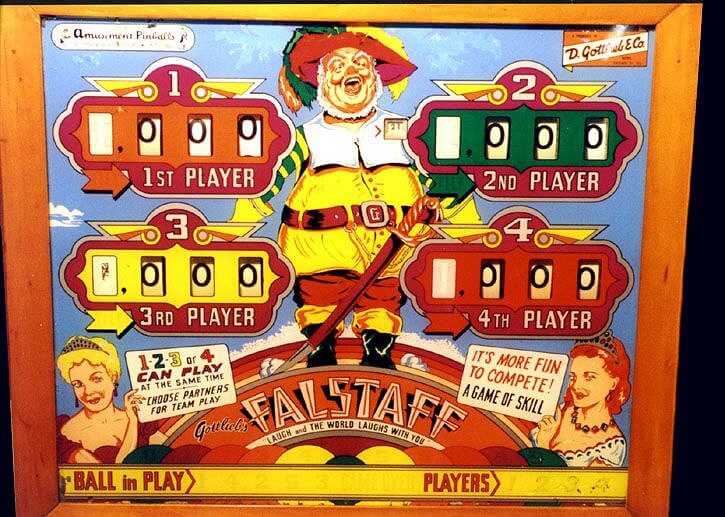
Gottlieb’s 1957 release, *Falstaff*, stands as a quintessential artifact of the Electromechanical golden age, showcasing the legendary collaboration between designer Wayne Neyens and artist Roy Parker. Built during an era when pinball was transitioning toward more interactive playfields, this four-player title leans heavily into the “gobble hole” craze that defined late-fifties design. With its whimsical, character-driven theme and a robust playfield packed with six passive bumpers and a trio of active pop bumpers, *Falstaff* demands a delicate touch rather than brute force. The centerpiece is the iconic Roto-target, a rotating mechanical bank that challenges players to hit specific sequences, forcing them to navigate the board with precision to avoid the dreaded gobble holes that act as both scoring hazards and game-enders.
The playfield layout is a masterclass in mid-century geometry, utilizing four rollunders to create a frantic, unpredictable ball path that keeps the action centered. Because the game relies on traditional reel-based scoring, every successful shot against the Roto-target feels like a hard-won victory against the machine’s mechanical complexity. With only 850 units ever produced, *Falstaff* has become a prized collector’s item, offering a distinct, high-tension experience that rewards players who can master the rebound angles of the passive bumpers. It is a charming, albeit punishing, reminder of a time when the “gobble hole” was the ultimate gatekeeper of a high score.