
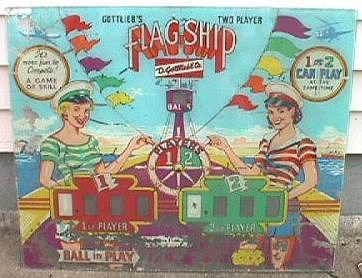
Flag-Ship, released by Gottlieb in 1957, stands as a quintessential example of the golden age of electromechanical design, pairing the mechanical mastery of Wayne Neyens with the unmistakable, whimsical art style of Roy Parker. This nautical-themed two-player game trades the high-speed ramps and magnets of modern machines for the deliberate, tactical challenge of a simpler era. With a limited production run of just 1,250 units, it remains a sought-after piece for collectors who appreciate the tactile satisfaction of reel-based scoring and the classic, wood-rail aesthetic that defined mid-century arcades.
The playfield layout is a masterclass in space management, centered around a trio of gobble holes that demand precise aim and nerves of steel. Unlike contemporary designs that reward relentless flailing, Flag-Ship forces the player to engage with its four pop bumpers and two passive bumpers, which act as unpredictable gravity wells that can either extend your ball time or cruelly deflect your shot into a scoring drain. The six standup targets offer consistent, point-building reliability, but the true tension lies in navigating the playfield to avoid the gobble holes while hunting for the high-scoring bonus thresholds that define a successful session.
Strategy on this machine is defined by discipline rather than speed. Because there are no modern ball-save mechanics or complex multiball modes to bail you out, the core objective is to master the momentum of the flippers to keep the ball away from the center-field hazards. Players should prioritize the standup targets to build their score incrementally, treating the ball as a precious resource that must be guided with soft, controlled taps. It is a game of rhythm and restraint—a vintage sailing vessel that requires a steady hand to steer through the choppy waters of its mid-century design.