
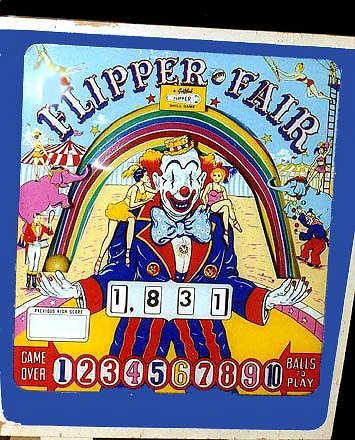
Flipper Fair, released by Gottlieb in 1961, serves as a quintessential masterclass in mid-century electromechanical design. Penned by the legendary Wayne Neyens with the unmistakable, whimsical aesthetic of Roy Parker, this single-player machine invites you into a vibrant carnival world that prioritized high-stakes endurance over simple point accumulation. As a classic “add-a-ball” title, the game shifts the objective away from chasing high scores and toward the more frantic, addictive pursuit of extending your turn by keeping the ball in play.
Beneath the glass, the playfield is a tight, reactive arrangement of four pop bumpers and two passive bumpers that dictate the chaotic flow of the ball. The mechanical layout relies on a clever series of three standup targets and a rollunder gate, forcing players to navigate the playfield with precision rather than brute force. Because the game rewards the player with extra balls rather than free games, the tension builds naturally; you aren’t just playing for a score, you are playing to survive the carnival, turning every successful shot into a reprieve that keeps the game alive.
For those looking to master this classic, the key is to respect the geometry of the two-flipper setup. Since the game lacks the modern complex multiball modes of contemporary machines, success relies on dead-flipping and controlled trapping to manage the unpredictable rebounds off the pop bumpers. With only 1,150 units produced, Flipper Fair remains a highly sought-after artifact of the “add-a-ball” era, offering a pure, stripped-down experience that highlights the brilliant mechanical simplicity that cemented Gottlieb’s reputation during the golden age of pinball.