
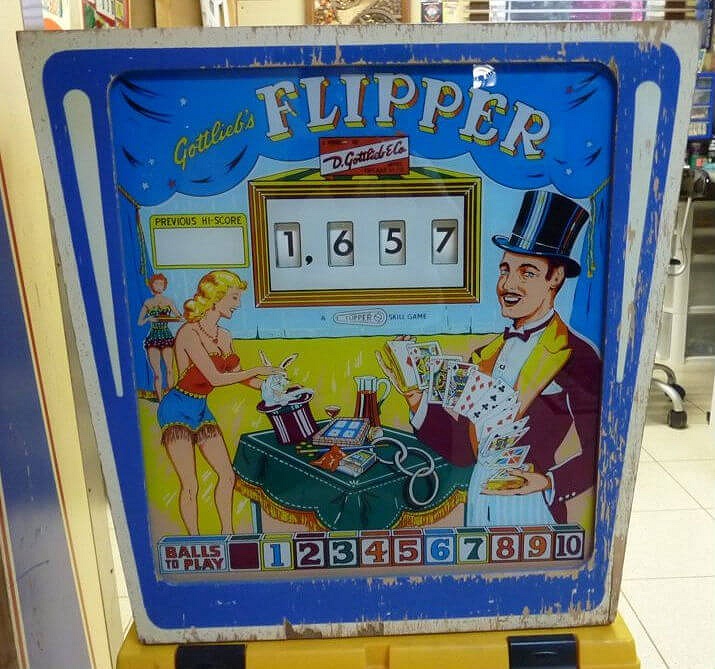
Gottlieb’s 1960 classic *Flipper* stands as a definitive pillar of early electromechanical design, marking a pivotal moment where the industry shifted from simple ball-management to active skill-based play. Conceptualized by Alvin Gottlieb and brought to life by the legendary design duo of Wayne Neyens and artist Roy Parker, this machine was a pioneer of the “Add-A-Ball” specialty. While modern tables focus on deep rule sets and digital modes, *Flipper* relies on the tactile satisfaction of its two flippers, three pop bumpers, and a pair of notorious gobble holes that demand precision to avoid.
The playfield layout is an exercise in minimalist tension, featuring a strategic standup target and a rollunder that force players to navigate the board with deliberate care. Because the machine was engineered for the Add-A-Ball format, the gameplay loop emphasizes extending your session through accurate shot-making rather than chasing high-score multipliers. The aesthetic, defined by Roy Parker’s iconic mid-century art style, captures the wholesome, vibrant spirit of the era, turning every successful shot into a battle against the inevitable drain.
With only 1,100 units produced, *Flipper* is a rare artifact that offers a pure, unadulterated look at how the game evolved during the post-war boom. It lacks the bells and whistles of contemporary hardware, but for the purist, it remains a masterclass in geometry. Mastering the game requires a deep familiarity with the rebound physics of the passive bumpers and the timing needed to keep the ball away from the gobble holes, making it a challenging, rhythmic experience that rewards steady hands and a keen eye for ball trajectory.