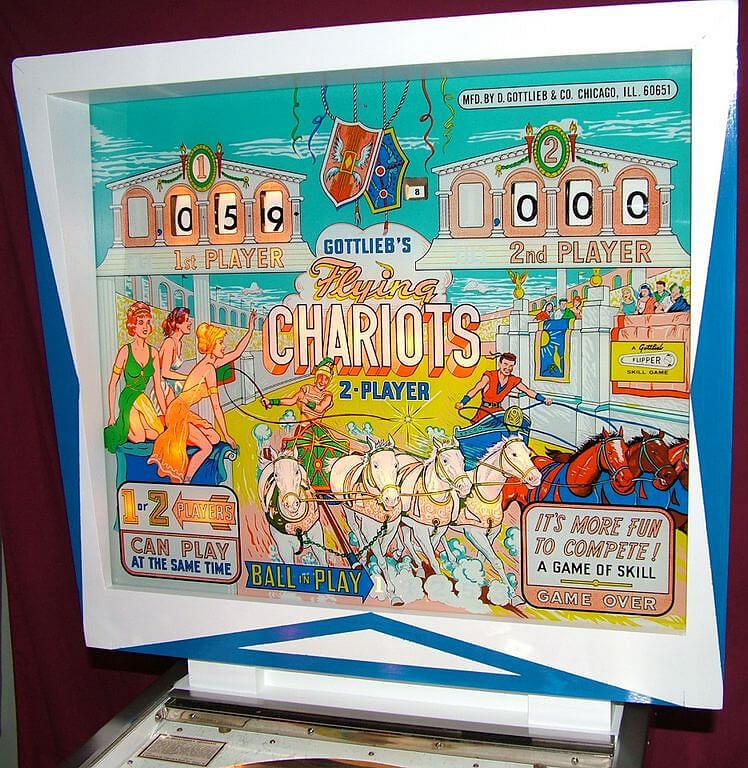
Flying Chariots, released by Gottlieb in 1963, stands as a quintessential relic of the golden age of electromechanical pinball. Designed by the legendary Wayne Neyens with vibrant, period-perfect backglass and playfield art by Roy Parker, the game leans into a Greco-Roman historical theme that feels both grand and surprisingly compact. It is a dual-player machine that relies on the satisfying clack of mechanical score reels and the raw, kinetic energy of a playfield stripped of modern digital distractions.
The mechanical layout is a masterclass in simplicity, defined by a symmetrical array of four pop bumpers and five passive bumpers that act as high-traffic obstacles. With two flippers and a trio of targets to aim for, the gameplay demands precision rather than complex rule-set management. The inclusion of dual outlanes on both the left and right sides creates a high-stakes environment where ball preservation is your primary objective. It is a game that rewards players who can master the rhythm of the bounce, utilizing the passive bumpers to keep the ball in play while hunting for those elusive high-scoring targets.
With over 3,400 units produced, Flying Chariots remains a fixture in the collections of those who appreciate the tactile, analog experience of early 60s design. It lacks the bells and whistles of contemporary machines, but its brilliance lies in that very scarcity of features; every shot matters, and the punishing outlane configuration ensures that a high score is a hard-won badge of honor. For the purist, this machine serves as a pristine example of how Neyens and Parker could transform a simple board into a compelling, fast-paced historical challenge.