
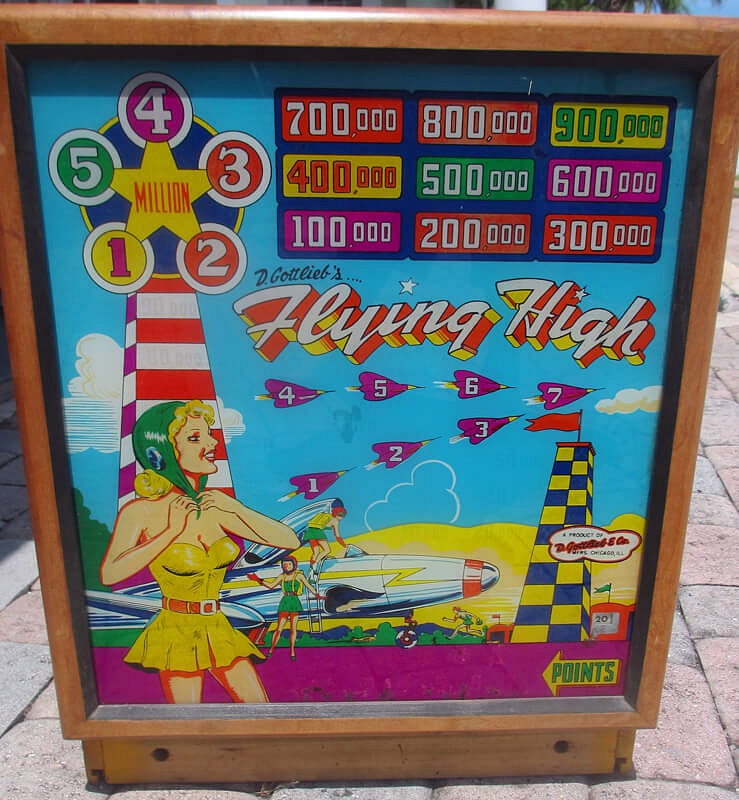
Flying High, a 1957 classic from Gottlieb, serves as a quintessential masterclass in mid-century electromechanical design. Penned by the legendary Wayne Neyens with the unmistakable, whimsical illustrative touch of Roy Parker, this single-player machine captures the golden age of aviation with charming simplicity. Rather than overwhelming the player with complex toys, the playfield relies on a disciplined, symmetrical layout that emphasizes precision over spectacle, challenging the player to navigate a dense network of bumpers and traps that represent the hazards of early flight.
The mechanical heart of the game revolves around its impressive array of eight trap holes, which demand a high degree of control and accuracy. With only two flippers at your disposal, the strategy shifts toward mastering the rebound angles provided by the two active pop bumpers and the seven passive bumpers that clutter the playfield. Success in Flying High is less about hitting a specific “mode” and more about the rhythmic, deliberate navigation of these holes; missing a shot often means the ball is swallowed into a trap, punishing sloppy play while rewarding those who can skillfully manage the chaotic caroms generated by the passive bumpers.
With only 1,400 units produced, Flying High stands as a rare, refined artifact of the late fifties. It is a quintessential Gottlieb experience: demanding, elegant, and visually evocative of a time when air travel was a romantic adventure. For the modern collector, it offers a stark, refreshing contrast to the multi-ball madness of contemporary machines, forcing the player to slow down, respect the ball’s momentum, and treat every shot like a calculated approach to a landing strip.